Bidspirit auction | WEIZMANN, CHAIM. Complete Collection of
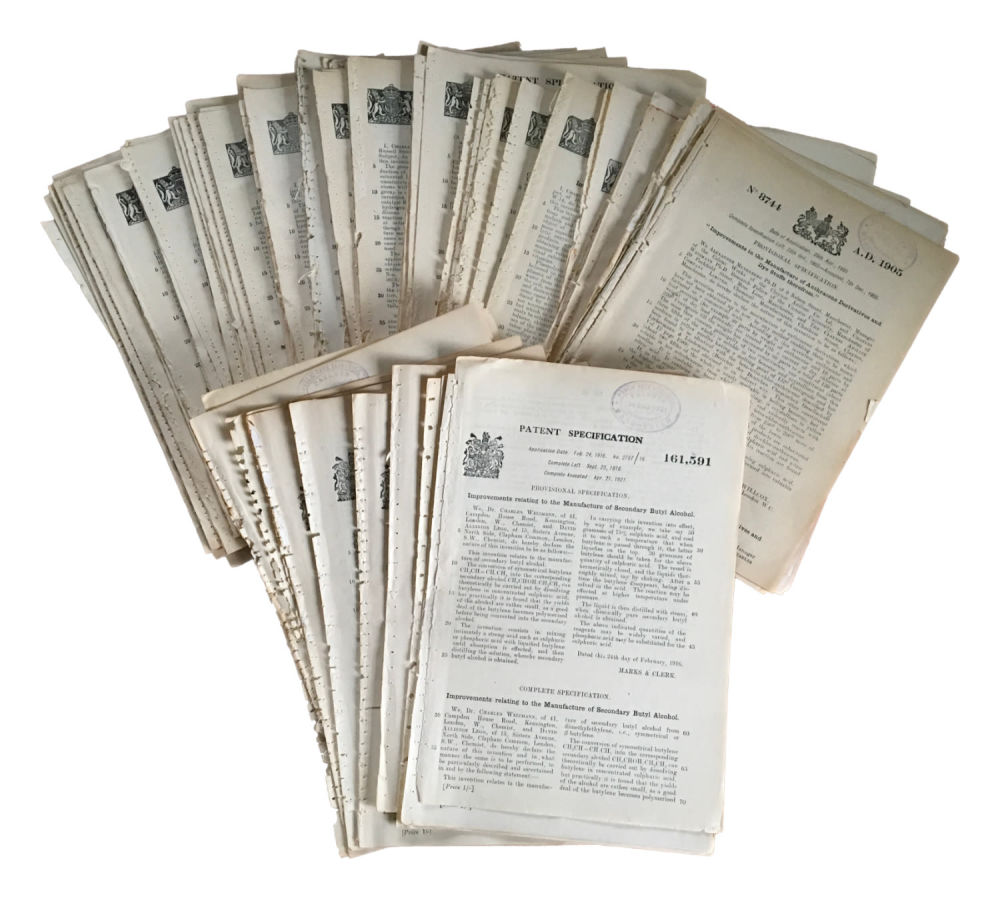
WEIZMANN, CHAIM. Complete Collection of Chaim (Charles) Weizmann’s Scientific Research Patents. Almost 90 individual printed patents. Ex-library. Original wrappers. 4to. (Manchester - London), 1905-1945. ALMOST 90 INDIVIDUAL PRINTED PATENTS. AN ASTOUNDING TESTAMENT TO CHAIM WEIZMANN’S SYNTHESIS OF SCIENTIFIC AND DIPLOMATIC ABILITIES. One of the founding fathers of the State of Israel and its first President, Chaim Weizmann (1874-1952), was also an accomplished chemist. Most famously, his breakthroughs in the production of acetone - a crucial component in casting cordite, the gunpowder of the time, contributed to Britain’s securing the upper hand in World War One over Germany. Weizmann leveraged his resulting clout in the political sphere, resulting in the momentous Balfour Declaration of 1917. An indefatigable man of action, Chaim Weizmann pursued his scientific and nationalistic ambitions in tandem. This can be seen from his earliest patents, dating from 1905-1908, which were achieved as a research fellow at Manchester’s Victoria University, working in the service of Clayton Aniline Company Limited. The owner of the company was Charles Dreyfus, a distant relative of the French Alfred Dreyfus, and president of the Manchester Zionist Society. It was Dreyfus whoin 1905 introduced Weizmann to Prime Minister Lord Arthur Balfour, who was the MP for the entrepreneur’s East Manchester constituency. The personal connection Dreyfus helped foster between Weizmann and Balfour (coupled with Weizmann’s later crucial breakthroughs related to acetone) would be instrumental in the later issuing of the Balfour Declaration. At the time, Weizmann’s duties for the company involved discovering new methods of producing synthetic dyes. Ten patents in the present lot include ‘improvements in the manufacture of isobornyl esters, anthracene derivatives and dye stuffs therefrom, camphene, obtainment of bye products, manufacture of pinene hydrochloride, camphor, treatment of liquid or oily pinene-hydrochloride and the obtainment of solid pinene-hydrochloride and camphene therefrom’. (The site of Weizmann’s laboratory is presently home to Academy Stadium, part of Manchester’s Sportcity. See https://en.wikipedia.org/wiki/Clayton_Aniline_Company) Weizmann’s next period of scientific creativity occurred in the context of his position as a senior chemistry lecturer at the University of Manchester. Conducting joint research with Professor William Henry Perkin (1838-1912), the ‘father of synthetic, organic dyes’ who had discovered the first such dye in 1856. Perkin was considered an elder statesman of the organic chemistry academic community, having essentially transformed the fashion industry with his discoveries. From 1910-12, Perkin and Weizmann conducted a plethora of experiments, with patents relating to improvements in the production of synthetic manufacture of coutchouc and halogen derivatives of organic compounds. At this stage in his scientific career, Weizmann began developing patents on his own. This professional maturity coincided with the onset of the Great War, which saw desperate governments looking towards their best minds for technological solutions to the chronic shortages and insufficiencies the war created in nearly every aspect of national economies. Weizmann leaned on his experience in production of synthetic material to pioneer the field of industrial fermentation. Specifically - in what would become Weizmann’s crowning scientific accomplishment - he discovered the clostridium acetobutylicum bacterium (also known as the Weizmann Organism), which could produce acetone, ethanol and butyl alcohol (n-butanol) from starch (see https://en.wikipedia.org/wiki/Acetone–butanol–ethanol_fermentation) The former was used in the production of cordite (the most commonly used explosive in the British military at the time) and the latter two were used for fuel and synthetic rubbers. In resource-starved Europe, the ‘Weizmann Process’ gave Britain a decisive advantage in what had become a war of economic attrition. The c. 6 patents from 1915-18 relate to ‘improvements relating to the manufacture and fermentation processes for the production of acetone and butyl alcohols, bacterial fermentation of carbohydrates and in bacterial cultures for the same and improvement in the production of glycols’. Weizmann’s discoveries ingratiated himself with Britain’s government, affording him privileged access to the men who would decide the fate of Palestine. It was at this time Weizmann’s scientific and political aspirations seemed to become one and the same. It was not lost on him that during 1916-17, British soldiers were conquering the very land in which the Zionists envisioned their future state, thanks to technology that Weizmann himself had engineered. After a flurry of meetings and communication, the Balfour Declaration,