Bidspirit auction | PEREIRA, ABRAHAM. Espejo de la
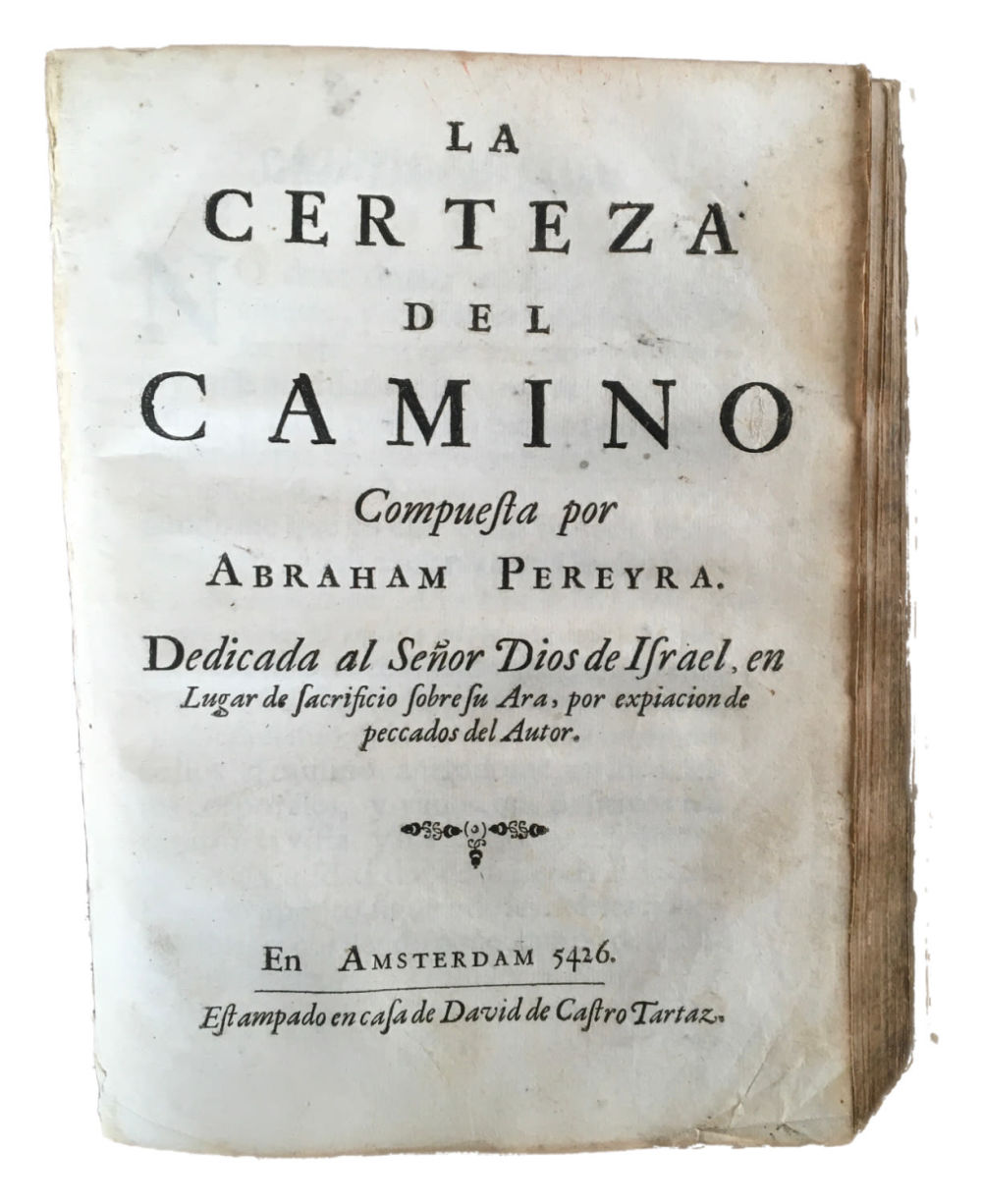
PEREIRA, ABRAHAM. Espejo de la Vanidad del Mundo [“A Reflection on the Vanity of the World.”] pp. (40), 568, (8). FIRST EDITION. * BOUND WITH: La Certeza del Camino [“The Certainty of the Path.”]. pp. (20), 316, (2). FIRST EDITION. Two works by Pereira bound in one volume. Text in Spanish with a few words of Hebrew. Floriated initials, tailpieces. Lightly browned, some wear; second work with occasional worming affecting a few letters at times. Contemporary mottled calf, spine gilt, rubbed. Thick 4to. Amsterdam and Alexander Janson, 1671. David de Castro Tartes, 1666, Amsterdam and Alexander Janson, 1671. Madrid-born Abraham Israel (alias, Thomas Rodriguez) Pereira (d. 1699) fled before the Inquisition to Venice and later Amsterdam. Fabulously wealthy, Pereira was for many years President of the Portuguese Jewish community of Amsterdam. He was also the primary patron of Menasseh ben Israel’s multifarious communal activities. Yet Pereira became a fervent follower of the pseudo-Messiah Shabbetai Tzvi, traveling in 1666 as far as Italy on his way to greet the Turkish impostor, only to turn back after learning of Tzvi's forced conversion to Islam by the Sultan. As patron of the Hessed Le’Avraham Yeshiva in Hebron, Pereira had received firsthand information from enthusiastic believers concerning the Messianic Movement and was invited by students there to join them “at this hour of grace.” Placing all his power and prestige to service, he journeyed in the Spring of 1666 toward the Holy Land to await the Messiah’s triumphant manifestation. Before departing Amsterdam he published the devotional work “La Certeza del Camino” directed to repentant sinners and intended to encourage the Shabbatean revival. Following the disintegration of the Sabbatian movement, this clearly devout man, eventually returned to Amsterdam to face huge financial losses resulting from his hasty departure. His ethical work “Espejo de la Vanidad del Mundo” displays Biblical, Greek and Roman classical erudition, as well as Rabbinic learning. It is divided into five discourses focusing upon such topics as the nature of the soul, the obligation to observe the precepts, fear and love of God, the tortures of Hell and the rewards of Heaven. It contains the approbations of three Sephardic Hahamim of Amsterdam: Isaac Aboab, Mosseh Rephael Aguilar and Josiah Pardo; as well as praise for the workby Doctor Isaac Orobio de Castro and a sonnet for the author by poet Daniel Levi de Barrios. Pereira’s writing is noted for autobiographical candor, something rare in the annals of Marrano literature, whose authors tend to be rather reticent about their lives in the Iberian Peninsula prior to their reconversion to Judaism. See G. Scholem, Sabbatai Sevi (1973) pp. 529-30; JNUL Catalogue, The Portuguese Community of Amsterdam in the 17th Century (1975) no. 153. H. Méchoulan, Hispanidad y Judaismo en tiempos de Espinoza: Estudio y edicion anotada de La Certeza del Camino de Abraham Pereyra, Amsterdam 1666, (Acta Salmanticencia), Ediciones Universidad de Salamanca, 1987. H. Méchoulan and G. Nahon, Gérard (eds.) Menasseh Ben Israel. The Hope of Israel (Oxford, 1987). https://en.wikipedia.org/wiki/Abraham_Pereyra and https://www.geni.com/people/Abraham-Israel-Pereira/6000000008180965281