Bidspirit auction | WASSERMAN, ELCHONON BUNEM (Rosh Yeshiva
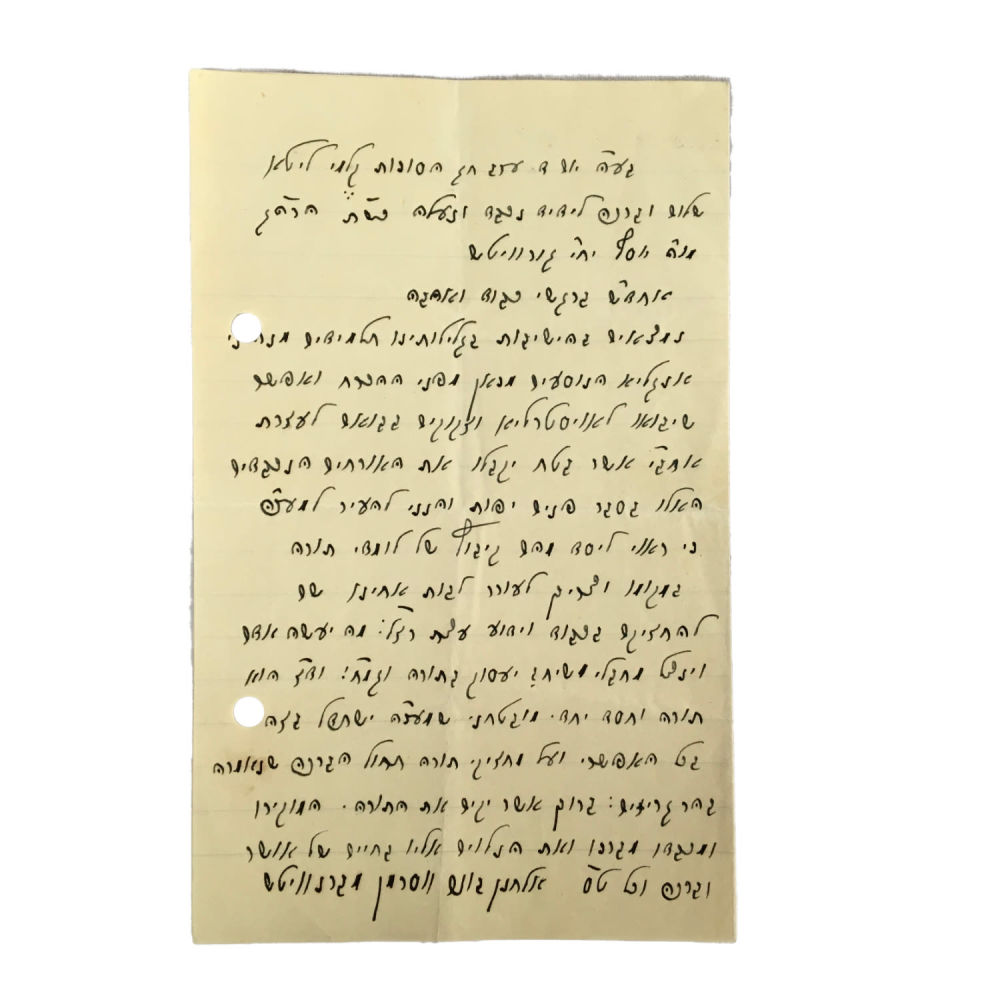
WASSERMAN, ELCHONON BUNEM (Rosh Yeshiva Baranowitch and pillar of Agudath Israel, 1875-1941). Autograph Letter Signed written in Hebrew to Rabbi Yosef Yechiel Gurevitch of Melbourne. Concerning the potential escape of Yeshivah students from Lithuania to Australia during World War Two. One page with integral blank. Two punch-hole punches. 8vo. Kelme, Lithuania, 1940, Erev Chag HaSukoth. A MOST IMPORTANT LETTER. The Lithuanian Yeshivah world watched helplessly as the Nazi’s invaded Poland, and took in countless refugees from the affected areas. However, as the Soviets turned their sights to Lithuania in the summer of 1940, students with foreign passports began to consider their pathways out of the war-torn continent. A group of English, American and Canadian students, hailing from Yeshivoth including MIR, KAMINETZ, GRODNO AND KLETZK, gathered in Kelme to assess their options. Liaising with the British consulate in Kaunas (Kovno), they were told their only option was to escape to Australia, crossing Russia via the Trans-Siberian railway and sailing to Brisbane via Vladivostok. (Traveling directly to England, Canada or America was impossible, as it would entail crossing submarine-infested waters). Uncertain about the plan, and unsure if the Soviet occupation necessitated such a drastic escape-route, the group conferred with R. Elchonon Wasserman, who was spending the Yomim Noraim (High Holy Days) in Kelme. The Rav deliberated back and forth, concerned that the boys would be in danger if the Japanese entered the war. “ONE THING IS MOST IMPORTANT, ” R. ELCHONON DECLARED, “NO MATTER WHERE YOU GO, YOU WILL NOT BE ABLE TO AVOID THE CHEVLEI MOSHIACH (BIRTH-PANGS OF THE MESSIAH) UNLESS YOU DEDICATE YOURSELVES TO TORAH.” Presciently, the fear of Chevlei Moshiach was front and center in R. Elchonon’s mind at the time, as he again references them in his letter to R. Gurewitch, encouraging him to materially support the refugees, “as Torah and acts of kindness can save one from the birth-pangs of Messiah.” In fact, already before the war, R. Elchonon predicted that Nazism would bode poorly for European Jewry, as witnessed in his Ma’amar Ikvatha DeMeshicha. The students eventually decided to leave, a fateful decision that almost certainly saved their lives. This was especially significant as the small group of only 17 Jewish men, women and children, included future leaders of the Torah world on new shores. Included in the group were: R. NOSSON WACHTFOGEL (1910-98), future Mashigiach of Lakewood. Escaped with his fiancé Chava. The two were wed in a civil marriage so the Rebbetzin could leave Europe despite not having foreign citizenship, and married Halachically upon reaching safety. R. CHAIM GUTNICK (1921-2003), future rabbi of Melbourne’s Elwood Synagogue from 1958-2003, founder and president of Rabbinical Council of Victoria. This was the journey through which he reached Australia and changed the faced of Jewish life there. REBBETZIN BLUMA AND HENNY DESSLER , wife and daughter of R. Eliyahu Dessler, Mashgiach of Gateshead and Ponevizh. The family would be reunited only after the war ended. R. CHAIM DOV BER SILVER (1912-96) later to establish the Carlton Talmud Torah in Melbourne and serve on Israel’s Va’ad HaYeshivoth. R. SHLOMO DAVIS (1915-2017), future Maggid Shiur at Telz, Cleveland. Before they departed, and in the present letter, R. ELCHONON STRESSED THE CENTRALITY OF TORAH LEARNING - AND MATERIAL SUPPORT OF SUCH LEARNING - TO THE CONTINUED SURVIVAL OF THE JEWISH PEOPLE. R. ELCHANAN WASSERMAN was one of the most distinguished leaders of Eastern European Orthodoxy. Seen as the spiritual successor to the Chofetz Chaim, he served as the Rosh Yeshivah of Baranovitch for 20 years. He was abroad on a fundraising mission when Germany invaded Poland, yet returned to Europe to be with his students. He was murdered by Lithuanian Nazi collaborators in the Seventh Fort of Kaunas Fortress in the summer of 1941 (12th Tamuz). R. Yoseph Lipman Gurewicz (1885-1956) was born in Vilna and a devoted student there of R. Chaim Ozer Grodzenski. In 1930 he visited Australia on behalf of the Lithuanian Va’ad HaYeshivos and made such a positive impression upon Melbourne Jewry he was prevailed to take up the pulpit of the Carlton United Hebrew Congregation. In this position, and due to the dynamic community leader that he was, Gurewicz became a central figure in the intense struggle to obtain sanctuary in Australia for Jews desperate to leave Nazi-Europe.