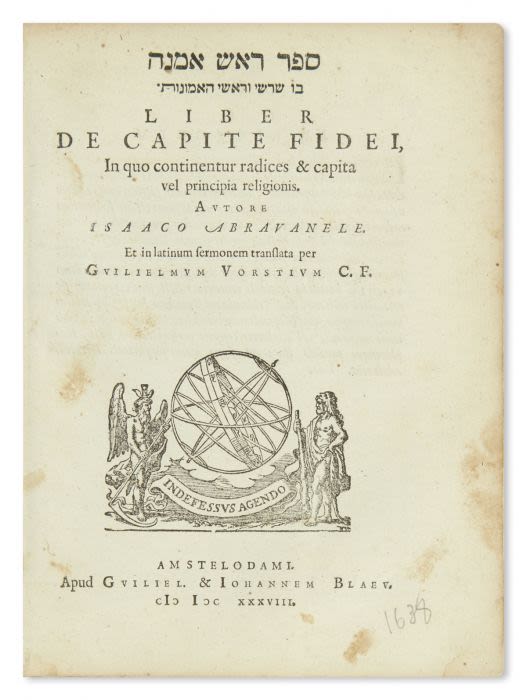
Bidspirit auction | ABRABANEL, ISAAC. De Capite Fidei
ABRABANEL, ISAAC. De Capite Fidei (Rosh Amanah). Latin text with Hebrew scattered throughout. Printer’s device on title depicting astrolabe flanked by angel and man with Blaeu family motto “Indefessus Agendo.” pp. 118, (10). Touch foxed. Contemporary vellum, worn. 4to. Amsterdam: G. & J. Blaeu 1638 The Latin translations of Isaac Abrabanel’s Rosh Amanah (and Maimonides’ Mishneh Torah) were issued simultaneously in Amsterdam in 1638. They were translated by Christian Hebraist, Willem Voorst (Guglielmus Vorstius). Aaron Katchen has analyzed Vorstius’ translations and concludes that Voorst’s agenda was to promote Christianity through Jewish sources, a fact that Vorstius’s teacher, Menasseh ben Israel, was clearly unaware of. See A.L. Katchen, Christian Hebraists and Dutch Rabbis (1984) pp. 235-47. Rosh Amanah [“The Pinnacle of Faith”] is Abrabanel’s most important work on philosophical-theological questions. The work is devoted to the championship of the Maimonidean Thirteen Principles of Faith against the attacks of Chasdai Crescas (Ohr Hashem) and Joseph Albo (Sepher Ha’Ikarim). The Latin translations of Isaac Abrabanel’s Rosh Amanah (and Maimonides’ Mishneh Torah) were issued simultaneously in Amsterdam in 1638. They were translated by Christian Hebraist, Willem Voorst (Guglielmus Vorstius). Aaron Katchen has analyzed Vorstius’ translations and concludes that Voorst’s agenda was to promote Christianity through Jewish sources, a fact that Vorstius’s teacher, Menasseh ben Israel, was clearly unaware of. See A.L. Katchen, Christian Hebraists and Dutch Rabbis (1984) pp. 235-47. Rosh Amanah [“The Pinnacle of Faith”] is Abrabanel’s most important work on philosophical-theological questions. The work is devoted to the championship of the Maimonidean Thirteen Principles of Faith against the attacks of Chasdai Crescas (Ohr Hashem) and Joseph Albo (Sepher Ha’Ikarim).