Subasta Bidspirit | Five Hebrew Works, with Latin
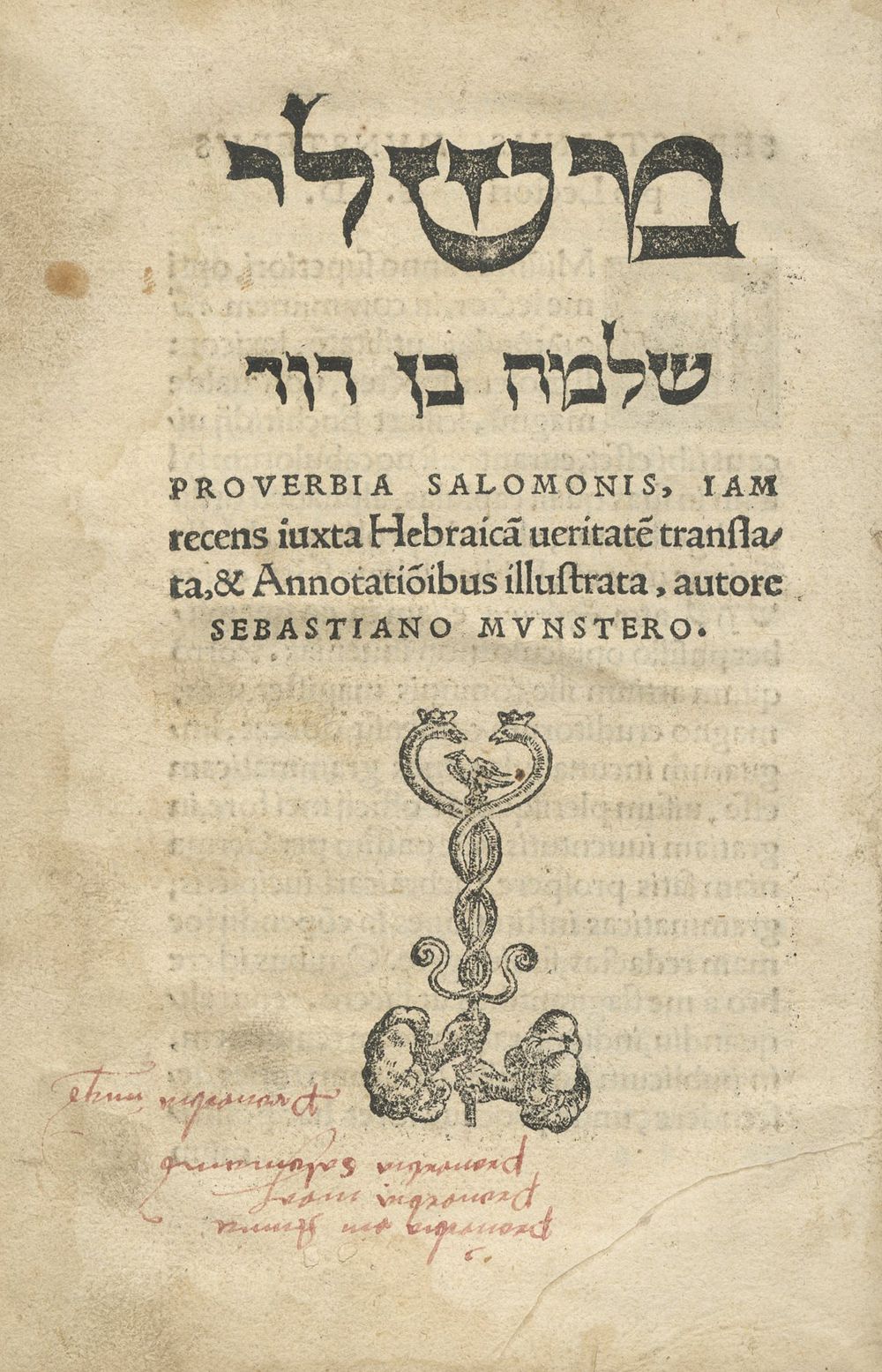
Five Hebrew Works, with Latin Translation by Sebastian Münster – Basel, 1524-1527 – Mishlei / Kohelet / Milot HaHigayon / Sefer HaHarkavah / Pirkei Eliyahu – Early Parchment Binding - Volume comprising five rare Hebrew works printed in Basel by Johann Froben, with introductions and Latin translations by Hebraist Sebastian Münster: 1. Mishlei – Proverbia Salomonis, with introduction and Latin translation by Sebastian Münster. Basel: Johann Froben, 1524. Hebrew and Latin on facing pages. In his introduction, dated 1524, Münster writes that the scholar Beatus Rhenanus encouraged him to publish the book as an aid to Hebrew study. This is followed by a recommendation to the reader by Hebraist Konrad Pellikan, praising Münster's editorial work in the format of the original text and translation on facing pages, which he notes is a much more effective method to learn a language than rote memorization of grammatical rules. At the end of the book are notes on the translation by Münster. Decorated initial letters; Froben's printer's device appears on title page and on verso of last leaf. Handwritten inscriptions and glosses (German) on margins of title page and other leaves. [132] leaves. 2. Kohelet – Ecclesiastes, with introduction and Latin translation by Sebastian Münster. Basel: Johann Froben, 1525. Printing details in colophon. Hebrew and Latin on facing pages. Münster's notes on translation at end of volume. On penultimate leaf, supplements and corrections to translation of Mishlei (the previous work in the volume). Decorated initial letters; printer's device on last leaf. [72] leaves. 3. [Milot] HaHigayon of R. Shimon, Logica Sapientis Rabbi Simeonis, by R. Moshe ben Maimon – the Rambam, with Latin foreword and translation, by Sebastian Münster. Basel: Johann Froben, 1527. Hebrew and Latin on facing pages. Evidently authored by the Rambam in his early years, originally written in Judeo-Arabic, concisely presents the essentials of Aristotelian logic, which influenced the Rambam's philosophy throughout his life. Münster's Latin translation is based on the first Hebrew translation by R. Moshe ibn Tibbon. It is unclear why Münster decided to ascribe the book to R. Shimon, even though the true author's name (R. Moshe son of R. Maimon) is given at the beginning. Some conjecture that he gave this name to the book in recognition of Prof. Simon Grynaeus (1493-1541), leading proponent of the Protestant Reformation, from whom he received the manuscript of this work, as he relates in the dedication. At bottom edge of colophon leaf, handwritten Hebrew sketch of the Aristotelian square of opposition in red and black. Decorated initial letters; Froben's printer's device on last leaf. [62] leaves. 4. Sefer HaHarkavah – Composita verborum & nominum hebraicorum, on Hebrew nominal and verbal morphology, by grammarian R. Eliyahu Bachur, with introduction and Latin translation by Sebastian Münster. Basel: Johann Froben, 1525. Hebrew and Latin. At beginning of book, two poems by R. Eliyahu Bachur (Ani Chomah and Hashem Elokai). The collation of the book begins with the letters ”Aa”, continuous with the collation of Makrei Dardekei by R. Eliyahu Bachur which Münster had published earlier that year (1525; see next lot). Decorated initial letters, Froben's printer's device on title page and on verso of last leaf. [84] leaves. 5. Pirkei Eliyahu, concise Hebrew grammar of ”letters, vowels and more” – Capitula Cantici Specierum, by grammarian R. Eliyahu Bachur, with introduction and Latin translation by Sebastian Münster. Basel: Johann Froben, 1527. Hebrew and Latin on facing pages. Comprised of four chapters: Perek Shirah, Perek HaMinim, Perek HaMidot and Perek HaShimushim; a sequel and supplement to the author's first book, Sefer HaBachur. Decorated initial letters; Froben's printer's device on title page and verso of last leaf. [98] leaves. 5 works in one volume. 16.5 cm. Good condition. Stains and minor defects. Tears and punctures to margins of a few leaves. Inscriptions and sticker on endpapers and interior of binding. Gilt edges. Early mounted leather tabs for navigation of volume. Early parchment binding, decorated, with pair of brass and leather clasps. Title of first book (Proverbia Salomonis) inscribed on front binding; some faded digits at bottom (probably dates of printing); feminine figure holding a cornucopia featured at center. Wear and defects to binding. Joseph Prijs, Basle, nos. 16, 17, 28, 21, 27.