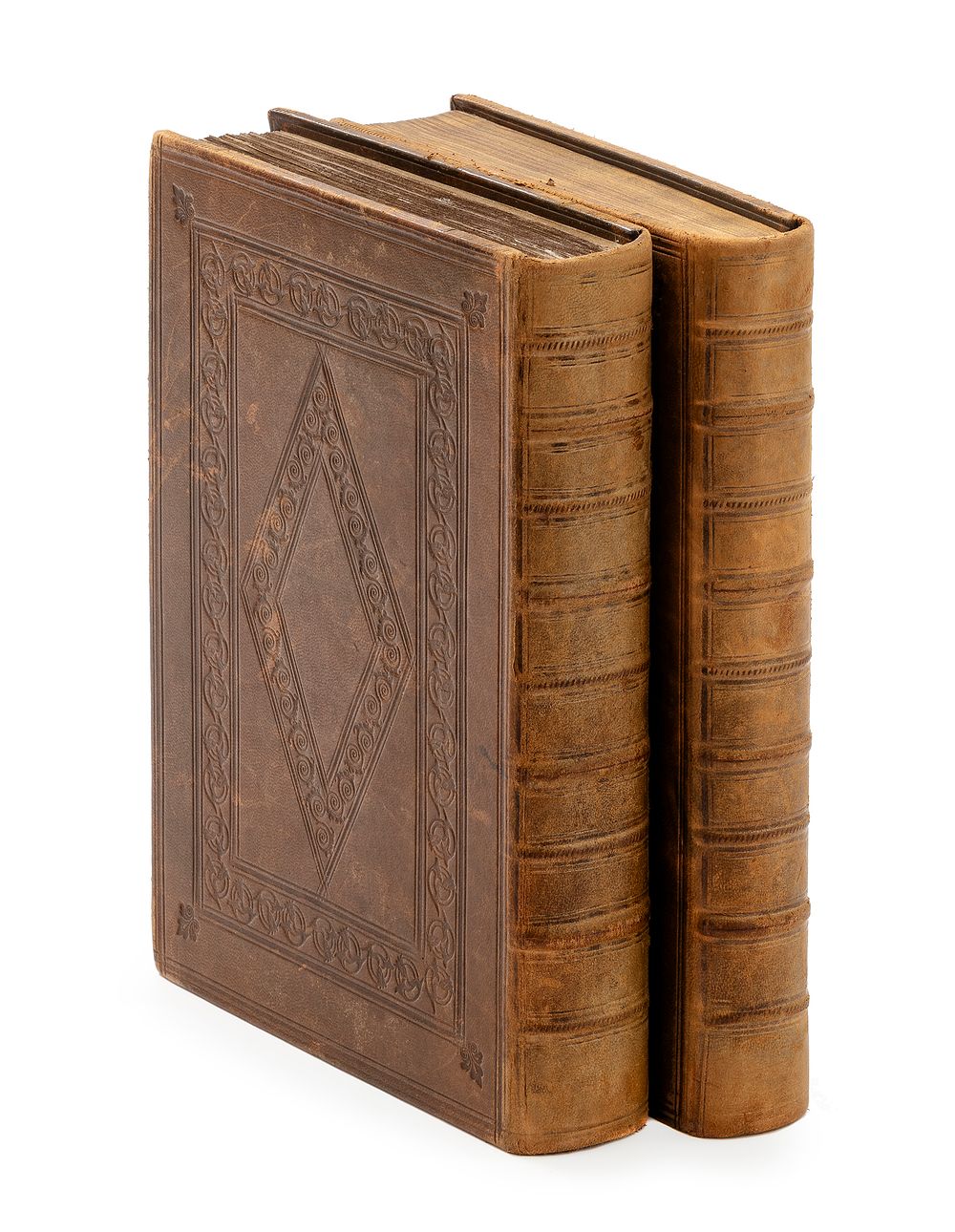
Subasta Bidspirit | Complete Set of All Four
Complete Set of All Four Parts of Shulchan Aruch – Rare First Edition of All Parts – Venice, 1564-1565 – Printed in the Lifetime of the Author, Rabbi Yosef Karo – The Classic Code of Jewish Law - Shulchan Aruch, complete set of all four parts, Orach Chaim, Yoreh Deah, Even HaEzer and Choshen Mishpat, by R. Yosef Karo. Venice: [Alvise Bragadin], 1564-1565. First edition of all four parts, printed in the author's lifetime. Two volumes. This is the complete first edition of all four parts of Shulchan Aruch – the classic halachic work of all times, and the foundation of Jewish life. R. Yosef Karo's Shulchan Aruch has been accepted throughout the Jewish world as a basic work of halachah. After completing his Beit Yosef commentary on the Tur, having seen its first three parts printed (1550-1553) and the fourth sent to the printer in Venice, R. Yosef Karo set out to author the Shulchan Aruch. At the end of each part, he notes its date of completion: Orach Chaim in Elul 1555, Yoreh Deah in Tamuz 1556, Even HaEzer in Shevat 1557 and Choshen Mishpat in Adar I 1558. Over three and a half years of consistent, uninterrupted labor, R. Yosef Karo wrote the four parts of the Shulchan Aruch, concisely summarizing the conclusions and halachic rulings reached in his earlier Beit Yosef. Over the years, the Shulchan Aruch became the classic code of Jewish Law, and most subsequent halachic works were based on it. Like the Rambam's Mishneh Torah and R. Yaakov's Tur, the Shulchan Aruch also garnered many commentators. The Shulchan Aruch spread rapidly soon after publication, reaching Ashkenazic countries as well. R. Moshe Isserles, the Rama, hurried to author his Mapah – glosses to the Shulchan Aruch, noting where the rulings and customs of the Ashkenazim differ, thus contributing to the work's acceptance in the Ashkenazic regions. In the author's introduction (printed at the beginning of each section), R. Yosef Karo describes his work's aim: ”I thank G-d verbally… for granting a lowly man such as myself to author… the great work I authored on the Arbaah Turim, which I named Beit Yosef… I thought that it would be right to gather the roses of its crystalline sayings in a short, encompassing, beautiful and pleasant verbiage, so that every Jew may be fluent in G-d's perfect Torah… Furthermore, the young students will study it constantly and memorize it, and they will be fluent in practical halachah from childhood… And I named this book Shulchan Aruch, for the reader will find all kinds of delicacies entirely arranged, preserved and clear, and I trust in G-d's supreme kindness that by means of this book, the land will be filled with knowledge of G-d, the small along with the great…”. Each title page features Bragadin's printer's device, comprised of three crowns (see: A. Yaari, Diglei HaMadpisim HaIvriyim, Jerusalem, 1944, illustration no. 18 and p. 131). This edition was proofread by R. Menachem Porto HaKohen Ashkenazi, and supervised by Meir son of Yaakov Parenzo (see: A. M. Habermann, HaMadpisim Bnei Yaakov Parenzoni BeVenezia, Areshet, I, 1959, pp. 61-90). Censorship expurgations to second volume (entire lines deleted with ink from several leaves in Choshen Mishpat part). Lengthy censorship inscription on last leaf of Choshen Mishpat, signed by censor ”Giovanni Antonio Costanzi”, dated 1753. Costanzi (1702-1786) was a Jewish apostate who had earlier served as Rabbi of Split for some eight years. He was active in Ancona and Rome ca. 1731-1753. In 1753 the Church's draconian policies on Hebrew book censorship reached their peak, even expanding beyond Italy. Costanzi had up to that point edited three indices of Hebrew books: permitted, permitted after censorship and forbidden. Shulchan Aruch was placed in the second category, as Costanzi notes in his inscription here: ”Corretto à norma…” (”Corrected in accordance with…”). For further details on the events of 1753, see at length: William Popper, The Censorship of Hebrew Books, New York, 1968, pp. 119-125. Inscriptions on title page of Orach Chaim part: ”This book belongs to me, Leon Alcostantin…”. Various inscriptions on verso of leaf, including ownership inscriptions (in Sephardic script): ”Purchased by me, the lowly servant Yitzchak Chen”. Notable handwritten inscription (with some spelling errors) on verso of last leaf with contents of Orach Chaim, discussing a numerical value: ”In section 582 in the laws of Rosh Hashanah, when we were studying with our teacher R. Eliezer Delmedigo…”. (R. Eliezer Delmedigo may possibly be the grandfather of R. Yosef Shlomo Delmedigo – the Yashar of Candia – and father of the Yashar's father R. Eliyahu Delmedigo). Signature on p. 8b in Orach Chaim part: ”Menachem Costantino”. Another signature on last leaf of this volume (on blank page): ”Menachem Alcostantino”. Gloss (trimmed) on p. 59a in Yoreh Deah part. Various inscriptions on verso of last leaf (blank) of Yoreh Deah, including birth inscriptions, a handwritten prayer,