Bidspirit auction | Rare Civil / Indian Wars
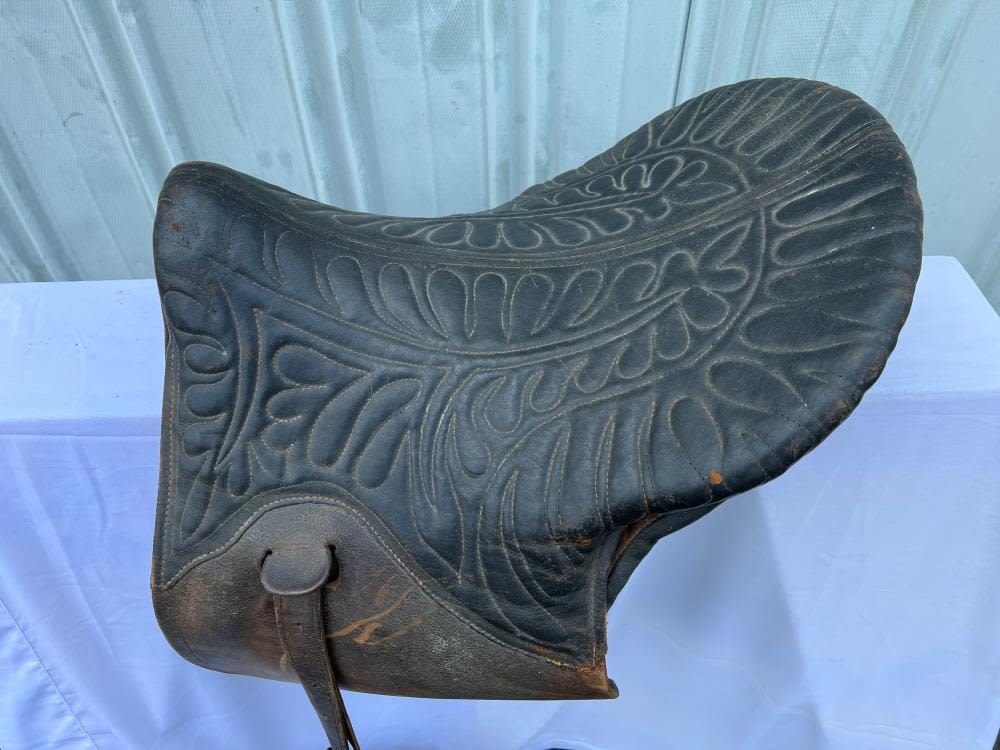
Rare Civil / Indian Wars 2nd Cavalry Officers Saddle - A very rare Indian Wars era, officers plantation style saddle profusely stitched all throughout the seat and elsewhere. Identified on the stirrup covers 2nd Cavalry which is period embossed with crossed swords and 10th cavalry insignia. Overall excellent condition for the age, one of the straps has separated, and needs to be repaired, but otherwise in excellent condition for the age. The 2nd Cavalry saw extensive and distinguished service in both the Civil War and Indian wars. This item came out of a house in Scranton Pennsylvania area, and is totally fresh and unresearched. At the onset of the Civil War in 1861, the regiment was recalled to the Eastern theater and redesignated on 3 August 1861 as the Second Cavalry Regiment. Thomas J. Wood was named the fourth Colonel of the regiment, but was promoted out of the job shortly after. Throughout the war, the 2nd Cavalry would be commanded by many company-grade officers such as Captains Wesley Merritt and Theophilus Francis Rodenbough. C Company was the last unit of the regiment to fight as dragoons, during the Battle of Wilson's Creek. For much of the war, the regiment was a key part of either the ”Reserve Brigade” or the ”Regular Brigade” of the Cavalry Corps of the Army of the Potomac and served in numerous campaigns and battles. They fought in numerous battles, including the Siege of Yorktown, the Second Battle of Bull Run, the Battle of Antietam, the Battle of Fredericksburg, the Battle of Chancellorsville, the Battle of Gettysburg, the Battle of Spotsylvania Court House, and the Battle of Cold Harbor. During the Battle of Fredericksburg in December 1862, SGT Martin Hagan of the 2nd Cavalry and a small group of troopers held a Confederate cavalry brigade at bay, covering the Union retreat across the river. This action was completed without the loss of a man or a horse, and SGT Hagan was awarded the regiment's first Medal of Honor.[5] The 2nd Cavalry was also present during the Stoneman Raid just prior to the Battle of Chancellorsville. This raid is regarded as the ”resurgence of the Union Cavalry.” During the Battle of Kelly's Ford, the 2nd Cavalry became the first Union cavalry regiment to engage Confederate General J.E.B. Stuart's cavalry in a head-to-head charge. This action hurt Stuart's reputation in the eyes of Southern leadership, just three weeks before the Battle of Gettysburg.[5] Leading up to the Battle of Gettysburg, the 2nd Cavalry fought a continuous recon and counter-recon with Stuart's cavalry until the two armies met at Gettysburg, Pennsylvania. Here, the regiment dismounted and skirmished the Confederates in a delaying action until the main Union force could reach the battlefield. During the Battle of Trevilian Station in June 1864, the 2nd Cavalry Regiment charged the Confederate Cavalry and smashed their lines. CPT T.F. Rodenbough led the charge and was wounded, and earned the Medal of Honor for his heroism in this brief but savage charge. Returning to duty in September 1864, he led the regiment in another charge during the Third Battle of Winchester. He was wounded again and lost his mount and right arm. First Sergeant Conrad Schmidt of K Company bravely rode back under fire to rescue his regimental commander.[5] Schmidt was given the Medal of Honor for his swift and courageous action. On 9 October 1864, the 2nd Cavalry, as part of the reserve brigade of the 1st Cavalry Division, the regiment attacked the flanks of the Confederate line, forcing them to retreat. During this action, PVT Edward Hanson of H Company earned the Medal of Honor for braving enemy fire to capture the flag of the 32nd Virginia Cavalry. The 2nd Cavalry Regiment earned 14 battle streamers and 5 Medals of Honor during their Civil War service. Lt William Orton Williams. Pvt William Preston Longley Deserter from Company B 2nd Cavalry 1870-1872 In 1895 Second Lieutenant Cornelius C. Smith, a Medal of Honor recipient, posed with his favorite horse, Blue, in front of his quarters while serving in the 2d Cavalry. Like the other early mounted units, many members of the Second Cavalry went on to higher ranks and command positions on both sides during the war. A former lieutenant of the regiment, Colonel Orton Williams, C.S.A who had been commissioned into the regiment on the recommendation of Robert E. Lee, was hanged as a spy by the federal authorities in 1863. When the Civil War ended, the 2nd Cavalry Regiment was sent west to fight against hostile Indian tribes and protect American settlers. With US troops focused on fighting Confederate forces in the east, the Indians of the frontier grew bolder. The vastness of the American frontier meant that the regiment was seldom together, and was spread out, often with only one troop occupying a post. In December 1866, 25 troopers of the 2nd Cavalry under LT George W. Grummond accompanied CPT William J. Fetterman in his expedition against Chief Red Cloud. In northern Wyoming,