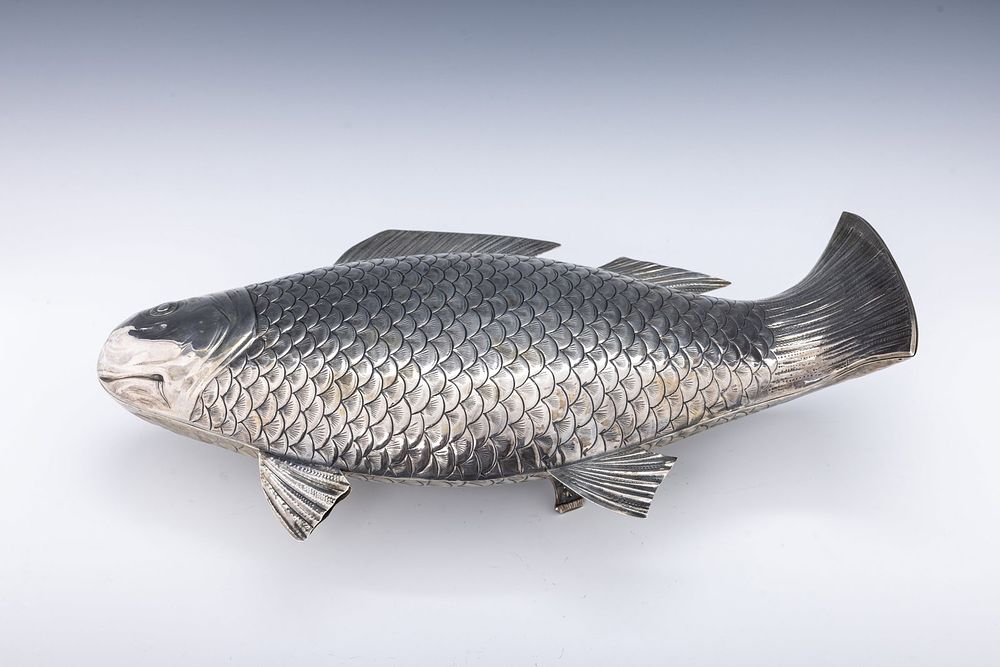
Bidspirit auction | THE FISH SHAPED SILVER DISH
THE FISH SHAPED SILVER DISH OF RABBI YISROEL FRIEDMAN OF HUSIATIN AND DESCENDANTS. Vienna, c. 1894. - Vienna, late 19th century. Made by Adalbert Ignatz Mayer (b. 1864) His trade license was issued in 1894 and was active in various addresses in Vienna until 1912, (Coincidentally, 1894 was the same year that Rabbi Mordechai Schraga Feivish Friedman passed away).The dish is hand wrought with one side (the cover) realistically chased and shaped like a fish (including fins and scales) with a head and a tail. The cover removes to reveal a inwardly tapering bowl as well as two stands, most likely to hold small spoons for salt and pepper. The bowl is removable and it is hollow underneath with two circular openings. These openings most likely held glass inserts for salt or pepper. The base with supports and continued fish decoration.This fish shaped dish is documented and pictured in a book that was written on the Husiayin Dynasty by Rabbi Dr. Meir Gruzman. A letter attesting to the provenance and authenticity of of this lamp accompanies it. Certified as authentic by Rabbi Dr. Meir Gruzman. At the Hasidic tish, the fish course is treated as a sacred food with deep mystical meaning. The Arizal taught that souls of the righteous may be reincarnated in fish and elevated through Sabbath meals. Fish symbolize the Sabbath, divine protection, and blessing. The Rebbe tastes the fish and distributes pieces as shirayim, which followers regard as carrying blessing. Hasidic leaders such as Rabbi Chaim Halberstam of Sanz and Rabbi Chaim Elazar Shapira of Munkacs attached special importance to the Sabbath fish. Rabbi Israel Friedman was the son of Rabbi Mordechai Schraga Feivel Friedman the first Husiatin Rebbe (May 29, 1834, Sedigura - May 28, 1894, Husiatyn) was the youngest (sixth) son of Rabbi Israel Friedman, the Ruzhiner Rebbe. The Ruzhiner indicated that a neshamah such as his, did not descend into this world in 2,000 years. He was named after his uncle Reb Mottle of Chernobyl during Reb Mottele's lifetime as the Ruziner explained, indicating that while R' Mottele was physically alive, he had not been in this world for 20 years. As children, a friendship existed between the Husyatiner and his nephew, Rebbe Yitzchok of Bohush, the son of his brother, Rebbe Shalom Yosef of Sadiger. Rav Yitzchok would later relate, as children, we would gather pieces of wood and make them into piles but we had the kavonos of Kevodo Malei Olam, that Hashem's presence fills the world. In 1865, he relocated to the Ukrainian town of Husyatin with his chassidim and his family. There he built a magnificent shule and court, which was right next to his home.The Rebbe would sit for hours connecting with Hashem in D'vekus, his family was so concerned that his soul would part from his body, that they would often distract him during the Dveykus to make sure he stayed alive. It has been told that Rabbi Shmuel Zelichover said that R' Mordechai was a warrior on behalf of the nation of Israel. ”Every Yid has his personal battle with the yetzer harah, but the Husyatiner was a general” fighting for all of Klal Yisroel” He died in 1894 and is buried in Husiatyn. His kever remains intact and accessible today.Rabbi Israel Friedman left Husiatin in 1914 because of World War I settling in Vienna. He married his cousin who was the granddaughter of the first Rabbi of Sadigura. When he made Aliya to Eretz Israel in 1937, and instructed his followers to do the same because of the surge of hatred toward the Jews. He indicated that ”they should leave even with only their socks”. He resided in Tel Aviv, in Bialik 19 and passed away in 1948. After him, the next Rebbe was his son Rabbi Yaakov Friedman (the Ohalei Yaakov), who had only one daughter, Rebbezin Miriam Bauminger.16” x 9” x 3.3|”