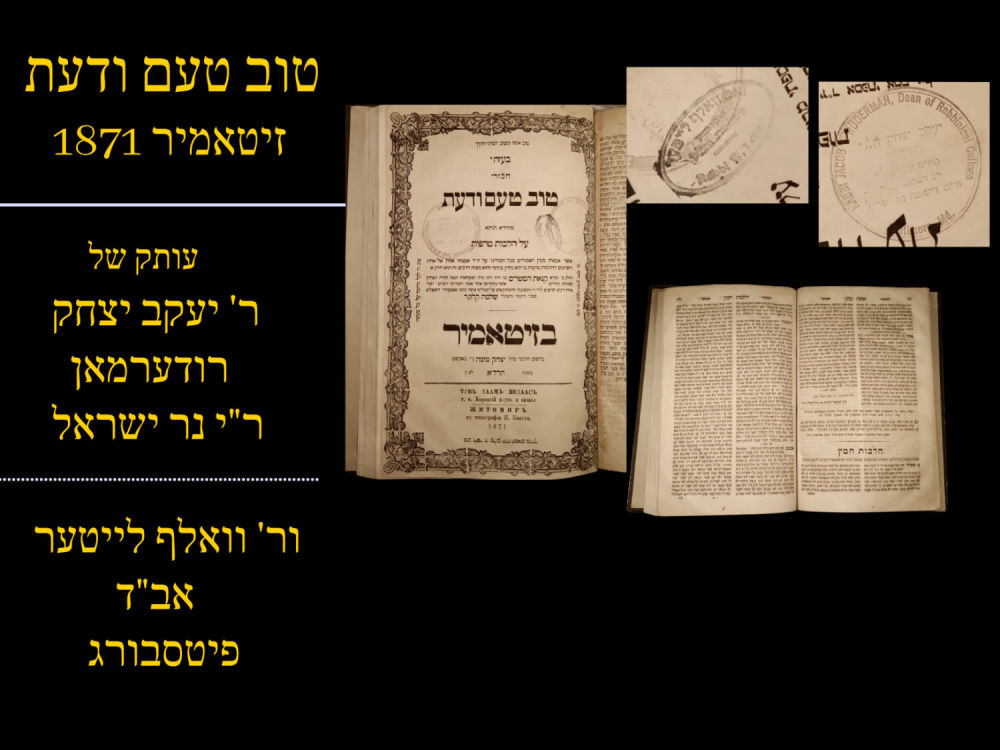
Bidspirit auction | Tuv Ta'am V'daas. Zhitomir, 1871. Also
Tuv Ta'am V'daas. Zhitomir, 1871. Also bound with Teshuvas Shmuel (missing title page) Copy of Rav Yaakov Yitzchok Ruderman, Rosh Yeshiva of Ner Yisroel of Baltimore, and Rav Wolf Leiter, Rav of Pittsburg R. Zev Wolf b. Nathan Leiter (1892-1974), Chief Rabbi of Pittsburgh Chairman of the Council of Rabbis of Pittsburgh and Director of the Maimonides Institute of Jewish Studies. Rabbi Leiter embodied a unique blend of Talmudic erudition and modern-day scholarship. He was born in the city of Zevaloy, Austria-Hungary to descendants of the most noted rabbinic families (Bach, Taz, Tosephot Yom Tov, Penei Yehoshua). At the age of six, he was already studying the Talmud and, at the tender age of eight, had written his first gloss (scholarly comment). At the age of twelve, he completed his first work, Dibhrey Hakhamim, a collection of responsa (erudite replies rendering decisions on problems in Jewish law). His queries on legal matters were discussed by some of the leading scholars of the day in their well-known treatises. By the time R. Leiter had reached the age of fourteen, his reputation as a prodigy had ranged far and wide and legal questions from throughout the state of Galicia were addressed to him. In 1911, R. Leiter became dayan and associate Rabbi of Trembovle, Austria-Hungary. At the outbreak of World War I, R. Leiter immigrated to Amsterdam and shortly thereafter was appointed Rabbi of the Eastern Jewish Community in Amsterdam. While there, he founded a Talmudic Torah School for refugee children and was director of the Dutch Relief work for war sufferers in Austria, sponsored by the Jewish communities of Netherlands. It was in Holland that R. Leiter published Die Stellung Der Frau In Talmud. Written in German, this short scholarly monograph discussed the all-embracing question of the position of the woman in Jewish life according to the Talmud. It was R. Leiter's view that there is a moral and spiritual imperative that the Jewish woman not be confined to and limited by the duties of the home alone, but should also have a broad Jewish education according to the capacities and interests of the particular woman. Professor Wensick, the eminent Dutch Orientalist of the day, characterized the work at that time as one of the most important scholarly contributions to the question of the Semitic attitude towards women. Thit: short monograph was a prime factor giving ideological impetus to the founders of the now world-famous Beth Yaakov School for Girls. In 1920 Beth David Vol. 1, a collection of Responsa by R. Leiter was printed and in 1952 reissued together with Vol. 2. Over the years it has been quoted in over two hundred and fifty scholarly works and in thousands of responsum. In 1920 he became a delegate to the United States on behalf of those European Rabbis displaced by the war. In the same year, he accepted the pulpit of the Adath Yeshurun Congregation of Brooklyn. In 1922, he was elected Rabbi of Congregation Machzike Hadath of Pittsburgh. In Pittsburgh R. Leiter became a well-known and highly respected figure. He was an active participant in the affairs of the Jewish community. He served as a member of the Board of Directors of the Federation of Jewish Philanthropies and also of the United Jewish Fund. He was a comrade of the Vaad HaPoel of the Union of Orthodox Rabbis of America; honorary president of the Pittsburgh Mizrachi; and the Pittsburgh delegate to the Jewish World Congress of 1934. excellent condition - טוב טעם ודעת, זיטאמיר, 1871 גם מחובר תשובת שמואל (חסר שער דף) מצב מצויין