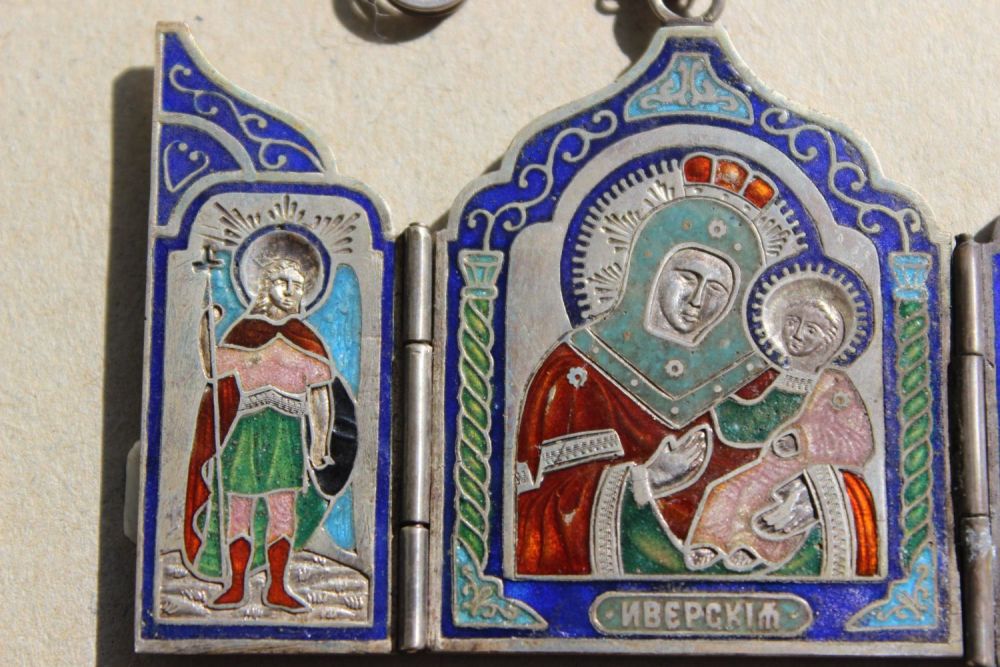
Bidspirit auction | Faberge enameled silver iconostasis -Iverskaya
Faberge enameled silver iconostasis -Iverskaya Mother of God, Imperial Russia - Faberge enameled silver iconostasis, Imperial Russia Four stamps: 1. Two headed Eagle (Russian Empire), 2. Karl Faberge, 3. 84 probe, % of silver 4. Saint George the Victorious, which means – Made in Moscow Width in full open position: 73 mm; Width in closed position: 37 mm; Height: 47 mm; Weight with chain: 37.4 g; Length of antique 84 silver chain: 53 cm; Provenance: from the family of Russian immigrants in St Petersburg, Florida, emigrated from Russia in 1917; References: 1) The Panagia Portaitissa (Greek: Παναγία Πορταΐτισσα; Georgian: ივერიის ღვთისმშობლის ხატი) also known as the Iviron Theotokos or Iverskaya in Russian,[1] is an Eastern Orthodox icon of the Virgin Mary in the Georgian Iviron monastery on Mount Athos in Greece, where it is believed to have been since the year 999.[2] According to the sacred tradition of the Eastern Orthodox Church it was painted by Luke the Evangelist.[3] The icon is referred to as ”Wonderworking” meaning that numerous miracles have been attributed to the intercession of the Theotokos (Mother of God) by persons praying before it. The synaxis (feast day) for this icon is on February 12,[4] as well as on Bright Tuesday,[2] and also on October 13 for the translation to Moscow of the Iveron icon.[5] 17th-century Russian version: Iverskaya. The icon belongs to a family of images of the Theotokos known as Hodegetria (Greek: Όδηγήτρια, ”she who leads the way”) after the prototype from Constantinople. In these icons, the Christ Child sits on his mother's left arm and she is depicted pointing to Christ with her right hand. Another famous icon based upon Hodegetria is Our Lady of Częstochowa. A unique characteristic of this icon is what appears to be a scar on the Virgin Mary's right cheek or her chin. A number of different traditions exist to explain this, but the one most commonly held by Orthodox Christians is that the icon was stabbed by a soldier in Nicaea during the period of Byzantine iconoclasm under the Emperor Theophilus (829–842). According to tradition, when the icon was stabbed, blood miraculously flowed out of the wound. The original in Iveron is encased in a chased riza of silver and gold covering almost all the figures except the faces, as is common with the most venerated icons. 2) Peter Carl Fabergé, also known as Karl Gustavovich Fabergé (Russian: Карл Гу́ставович Фаберже́, Karl Gustavovich Faberzhe; 30 May 1846 – 24 September 1920), was a Russian jeweller best known for the famous Fabergé eggs made in the style of genuine Easter eggs, but using precious metals and gemstones rather than more mundane materials. He was one of the sons of the founder of the famous jewelry legacy House of Fabergé.