Bidspirit auction | Tibetan copper gilded Buddhist fierce
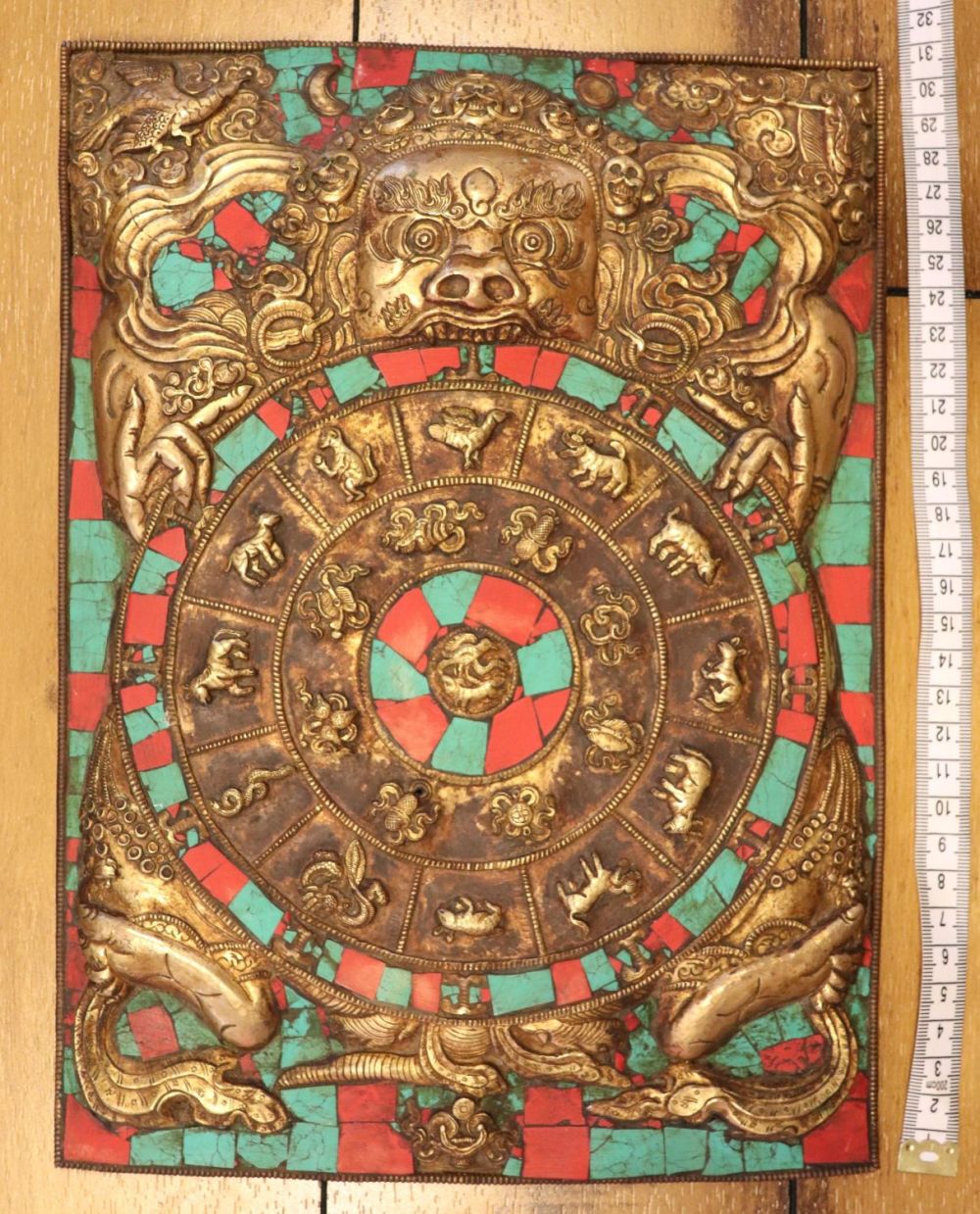
Tibetan copper gilded Buddhist fierce deity icon, 1600-1800 AD - Tibetan copper gilded Buddhist fierce deity icon, 1600-1800 AD Highly elaborated copper icon with semiprecious stones and gilded figure of Mahakala (or other fierce deity) holding the whole Universe in his body. Size: 11.75” x 8.5” = 29.8 cm x 21.7 cm Weight: 908 g; Provenance: made in Bhutan (?), then in 1940s - private collection in USA Mahākāla is a deity common to Hinduism and Tantric Buddhism.[1] In Buddhism, Mahākāla is regarded as the sacred Dharmapāla (”Protector of the Dharma”), while in Hinduism, Mahākāla is a fierce manifestation of the Hindu god Shiva and the consort of the goddess Mahākālī;[1] he most prominently appears in the Kalikula sect of Shaktism.[2][3][4] Mahākāla also appears as a protector deity in Vajrayana, Chinese Esoteric, and Tibetan Buddhism[1] (see Citipati), and also in the Chàn and Shingon traditions. He is known as Dàhēitiān and Daaih'hāktīn (大黑天) in Mandarin and Cantonese, Daeheukcheon (대흑천) in Korean, Đại Hắc Thiên in Vietnamese, and Daikokuten (大黒天) in Japanese. In Buddhism, wrathful deities or fierce deities are the fierce, wrathful or forceful (Tibetan: trowo, Sanskrit: krodha) forms (or ”aspects”, ”manifestations”) of enlightened Buddhas, Bodhisattvas or Devas (divine beings). Because of their power to destroy the obstacles to enlightenment, they are also termed krodha-vighnantaka, ”Wrathful onlookers on destroying obstacles”.[1] Wrathful deities are a notable feature of the iconography of Mahayana and Vajrayana Buddhism. These types of deities first appeared in India during the late 6th century, with its main source being the Yaksha imagery, and became a central feature of Indian Tantric Buddhism by the late 10th or early 11th century.[2]