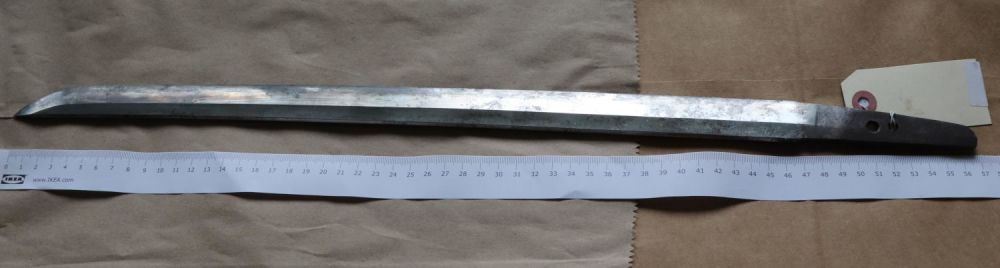
Bidspirit auction | Antique, 57.2 cm, Japanese Samurai
Antique, 57.2 cm, Japanese Samurai Wakizashi sword - Antique, 57.2 cm, Japanese Samurai Wakizashi sword; Overall length: 572 mm = 57.2 cm; Length of the blade (nagasa) only: 476 mm = 47.6 cm; Weight: 379 g; SORI (curvature): 3.0 mm; Nakago (tang): two holes; Shamon effect: present to some extent; TSUKA (handle): absent; SAYA (scabbard): absent; HABAKI (collar): absent; Provenance: Private collection of arms in Florida. Tantō (短刀, ”short blade”): A sword with a blade shorter than 30 cm. Tantō is generally classified as a sword, but its usage is the same as that of a knife. Usually one-edged, but some were double-edged, though asymmetrical. Wakizashi (脇差, ”side inserted [sword]”): A general term for a sword between one and two shaku long (30 cm and 60 cm in modern measurement), predominantly made after 1600. Generally it is the short blade that accompanies a katana in the traditional samurai daisho pairing of swords, but may be worn by classes other than the samurai as a single blade, also worn edge up as the katana. The name derives from the way the sword would be stuck at one's side through the obi (sash/belt).[8] Each Japanese sword is classified according to when the blade was made.:[10] • Jōkotō (上古刀 ”ancient swords”, until around 900 A.D.) • Kotō (古刀”old swords” from around 900–1596) • Shintō (新刀 ”new swords” 1596–1780) • Shinshintō (新々刀 ”new swords” 1781–1876) • Gendaitō (現代刀 ”modern or contemporary swords” 1876– present)