Bidspirit auction | Signed 作る Tanto - Japanese
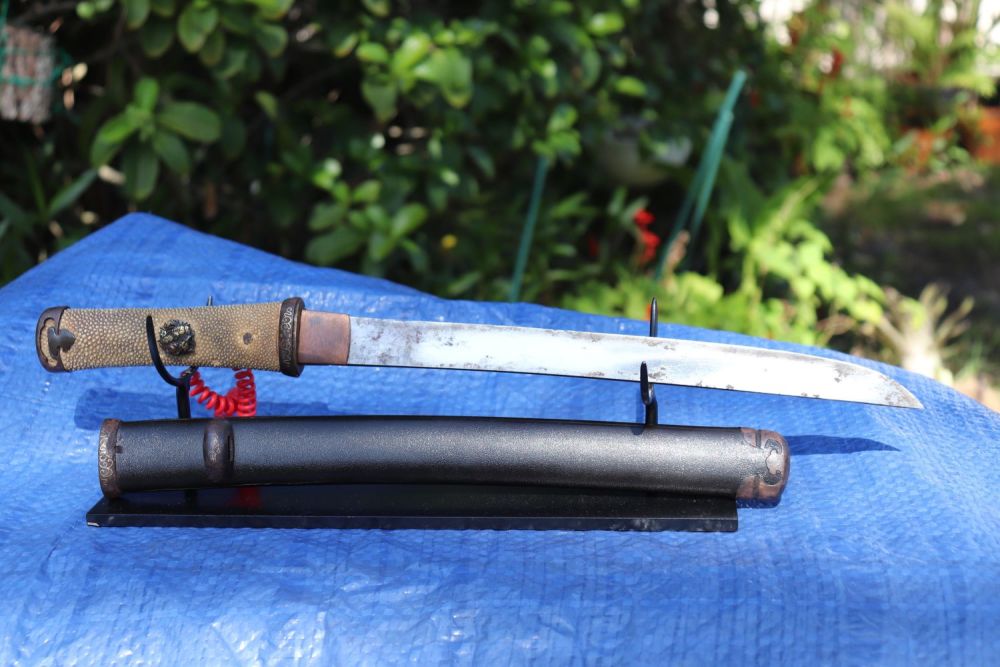
Signed 作る Tanto - Japanese antique Samurai sword, 31 cm - Japanese antique Samurai tanto sword, signed with 2 characters 作るtsukuru (make); Needs more cleaning and better translation. Overall length: 477 mm = 47.7 cm; Length of the blade (nagasa) only: 310 mm = 31 cm; Weight of tanto sword: 278 g; Total weight with scabbard: 389 g; Sori (curvature): 3 mm Nakago (tang): one round hole; Habaki (collar) – present; TSUKA (handle): present; SAYA (scabbard): wood; Provenance: Private collection of arms in Florida. The tantō is a dagger, but is used as a knife. The blade is single or double edged with a length between 15 and 30 cm (1 Japanese shaku). The tantō was designed primarily as a stabbing weapon, but the edge can be used for slashing as well. Tantō are generally forged in hira-zukuri style (without ridgeline),[1][5] meaning that their sides have no ridge line and are nearly flat, unlike the shinogi-zukuri structure of a katana. Some tantō have particularly thick cross-sections for armor-piercing duty, and are called yoroi toshi. A tantō (短刀, ”short sword”) [1] is one of the traditionally made Japanese swords[2] (nihonto)[3][4] that were worn by the samurai class of feudal Japan. The tantō dates to the Heian period, when it was mainly used as a weapon but evolved in design over the years to become more ornate. Tantō were used in traditional martial arts (tantojutsu). The term has seen a resurgence in the West since the 1980s as a point style of modern tactical knives, designed for piercing or stabbing. The production of swords in Japan is divided into specific time periods: • Jokoto (ancient swords, until around 900 A.D.) • Koto (old swords from around 900–1596) • Shinto (new swords 1596–1780) • Shinshinto (new swords 1781–1876) • Gendaito (modern swords 1876–1945)[10] • Shinsakuto (newly made swords 1953–present)[11]