Bidspirit auction | CW Clothing Invoice & Morning
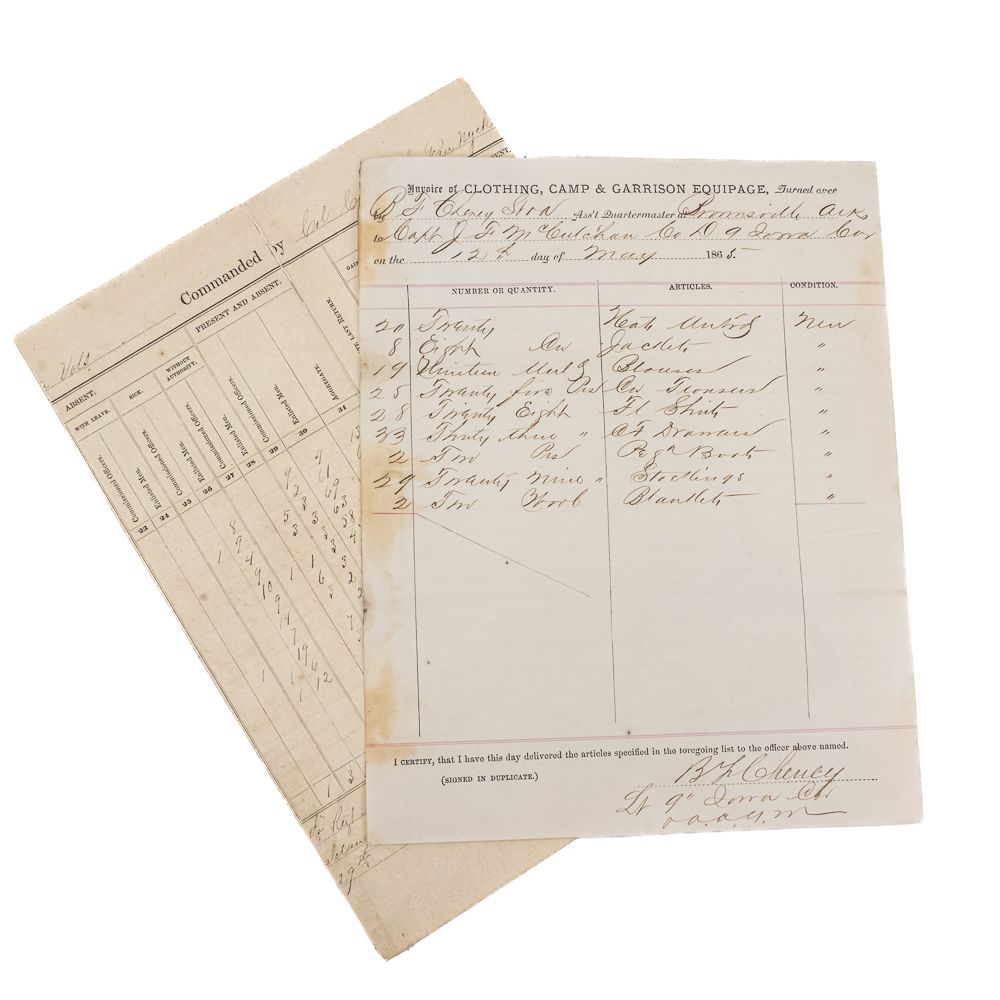
CW Clothing Invoice & Morning Report 56NY, 9th IA - This lot features a fascinating glimpse into Civil War logistics and personnel management through two original mid-19th-century documents. 1) The first is an ”Invoice of Clothing, Camp & Garrison Equipage” dated May 12, 1865, documenting the transfer of supplies from Lt. B.F. Cheney of the 9th Iowa Cavalry to Capt. J.F. McCutchan. The itemized list includes fascinating period gear such as ”Great Coats,” ”En. Jackets,” ”Prs. Peg’d Boots,” and ”Wool Blankets.” This invoice is a ”post-surrender” document, dated just a month after Lee's surrender at Appomattox. The Officer: Captain J.F. McCutchan (Company D) was overseeing the re-equipping of his men while stationed at Brownsville, Arkansas. The Context: While the major fighting had ended in the East, the 9th Iowa Cavalry was still actively performing garrison and patrol duty in the Department of Arkansas, dealing with ”bushwhackers” and maintaining order. The Items: The request for ”Great Coats” and ”Wool Blankets” in May might seem odd, but in the 19th-century military, these were often turned in during spring or replaced after a hard winter campaign to prepare for the next year's cycle. 2) The second document is a large, multi-fold ”Consolidated Morning Report” for the 56th Regiment of New York State Volunteers (the ”Tenth Legion”), commanded by Col. Charles H. Van Wyck, dated July 29, 1862. This expansive ledger tracks the strength and status of the regiment during the height of the conflict. This report was drafted just weeks after the grueling Seven Days Battles (June 25 – July 1, 1862). At this exact time, the ”Tenth Legion” was stationed at Harrison’s Landing, Virginia, resting under the protection of Union gunboats after the retreat from Richmond. The Commander: Colonel Charles H. Van Wyck was not just a soldier but a sitting U.S. Congressman. He famously fought in the Battle of Fair Oaks (May 1862), where he was wounded in the knee. The Regiment: By July 29, the regiment was severely depleted. Having faced heavy combat at Fair Oaks and Malvern Hill, the ”Consolidated Morning Report” you hold likely reflects a unit struggling with high rates of disease and exhaustion in the swampy Virginia summer. In summary, the 56th NY report is particularly valuable because it captures the regiment's status during the Peninsula Campaign, one of the most famous operations of the war. The 9th Iowa invoice is a prime example of the massive logistical ”cleanup” that occurred in the weeks following the war's end. Both pieces show authentic age-related wear, including heavy fold lines, minor foxing, edge toning, and small tears consistent with field-use documents of this era, though the ink remains remarkably legible. Dimensions: Invoice: H 10”, W 8”; Morning Report (folded): H 10”, W 4”; Morning Report (unfolded): H 10”, W 30”. Please see photos.