Bidspirit auction | William Holt Yates Titcomb (1858
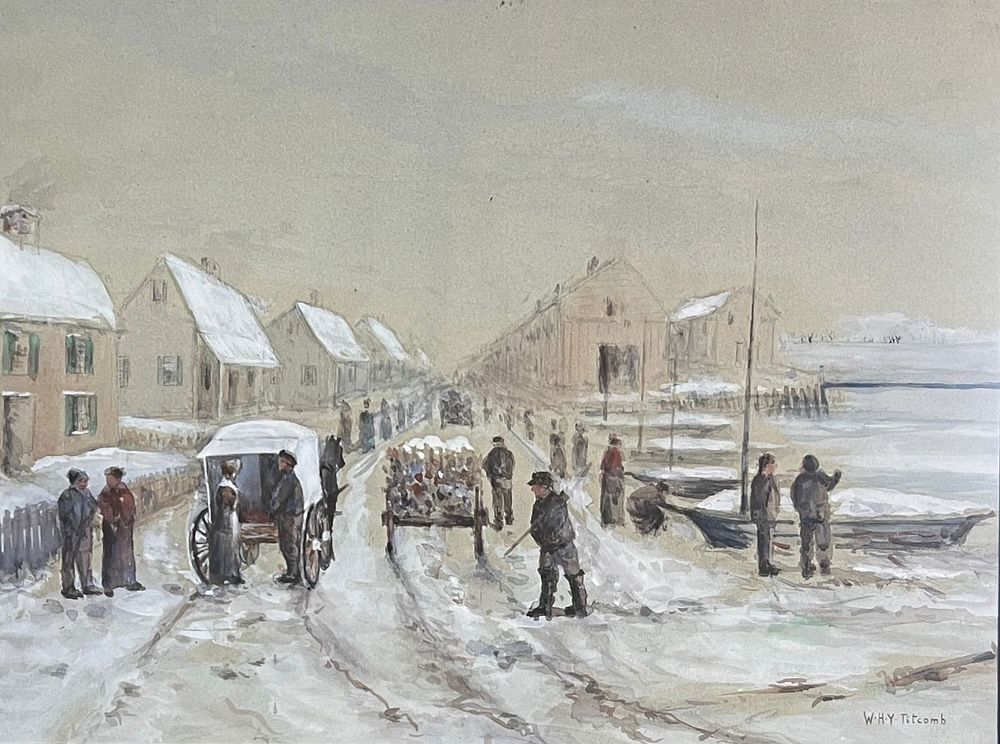
William Holt Yates Titcomb (1858 - 1930) England - William Holt Yates Titcomb (1858 - 1930) Watercolor and gouache on paper, signed lower right ”W.H.Y. Titcomb”, piece measures. Born in Cambridge (22 February, 1858), the artist attended Westminster School, then studied art at South Kensington and at Anwerp with Charles Verlat (1879). In 1880 he travelled to Burma where his father was Bishop of Rangoon, and produced highly finished, intricate works with (for him) a new set of colour values. Next he studied at Julian's in Paris, under Boulanger and Lefebvre, and went on to the new Herkomer's at Bushey, staying for the full two years. The social-realism of his later work indicates Herkomer's great influence. In 1887, he settled in St Ives, his reputation building from Primitive Methodists at Prayer, St Ives exhibited at the RA (1889), on a theme of the importance of religion to the lives of fisherfolk, to which he returned again and again.In 1891, the Census records show that he was lodging with the Hosking family at Trenwith House, Halsetown (and also erroneously that he was born in London). He married a fellow artist, Jessie Morison in 1892 (St Ives Marriage Register, 4 Feb 1892 by Banns), and their children, Frank and Loveday, were born in 1898 and 1900 respectively. In 1898 he was one of the signatories for the Glanville letter, expressing concern about proposed building developments for St Ives. Both he and his wife Jessie exhibited a painting each in the Whitechapel Exhibition of 1902. Believing German education to be superior at that time, they moved to Dusseldorf in 1905 but with the rise of nationalism there they returned to Bristol in 1909. His final major oil, a commission, was John Wesley preaching to the Mayor and Corporation of Bristol 16 March 1788 that was exhibited at the RA in 1918. During the 1920s the Titcombs travelled extensively throughout Europe, with several extended stays in Venice, he working in watercolours and selling wherever they went. In 1921 it appears that he also spent some time painting in Polperro. In 1925 he staged an exhibition of 89 watercolours at Walker's Gallery in New Bond Street, which was well received and visited by the Queen. With William's health declining they moved first to Menton but returned finally to Bristol where he died, on 7th September 1930. He was a humble man, not interested in self-promotion or art politics, and he not only worked abroad a great deal, but kept out of the public gaze. David Tovey's outstanding historical work on the St Ives painters and their lives has done much to bring about a renewed appreciation for Titcomb's talents. Condition: The absence of a condition report does not imply an object is free of defects. All items may have normal signs of age and wear commensurate with their age; these issues will likely not be mentioned in the condition report. Please contact the auction house before the auction with any condition questions. Questions about condition will not be answered after purchase. Condition reports are provided as a courtesy, and we are not responsible for any errors or omissions. Important note on frames: Frames are not guaranteed to be in the same condition as they are in the item photograph. Due to handling and shipping, many frames, especially antique ones, are prone to losses. If you have questions about the condition of a frame, please contact us prior to the auction.