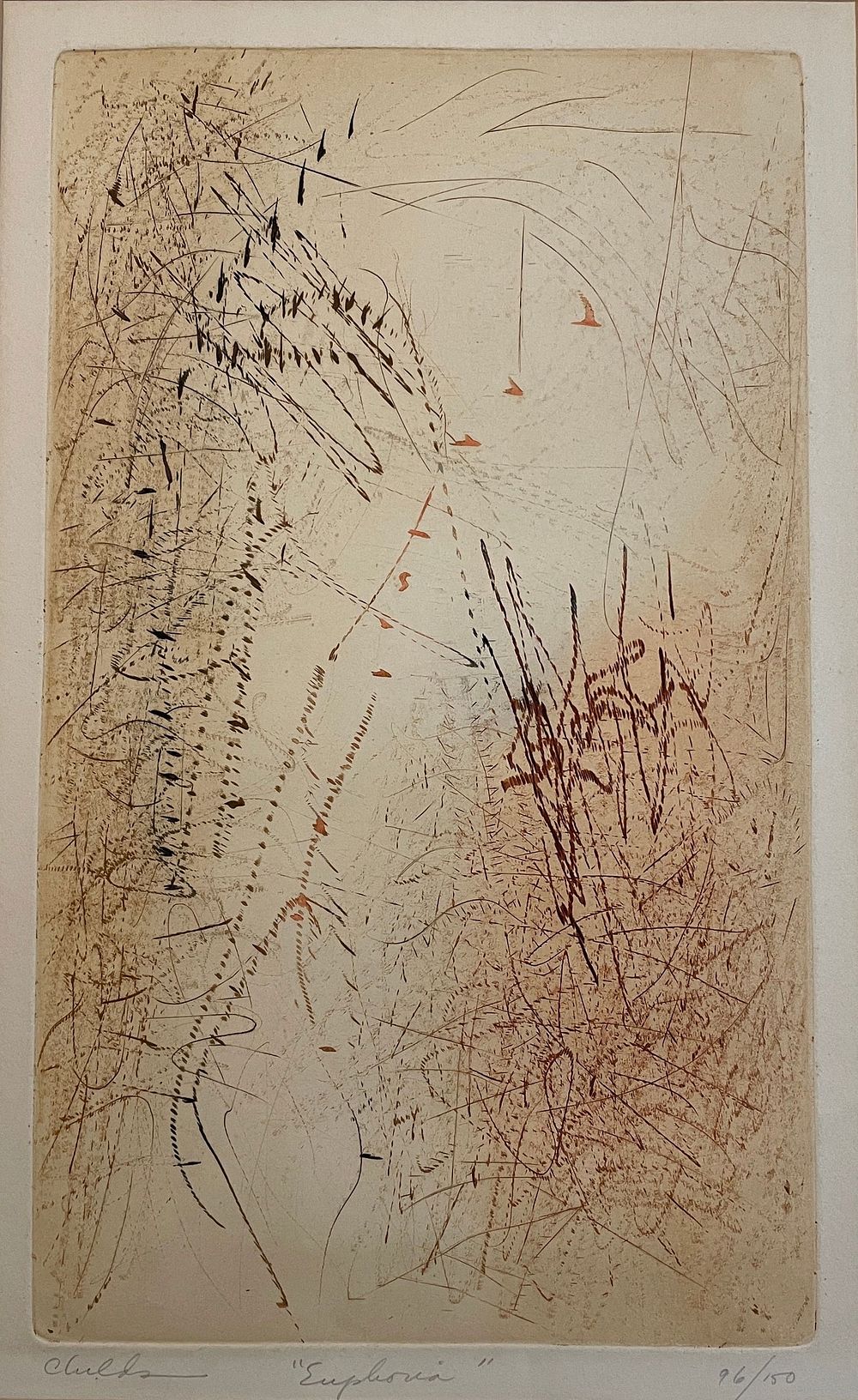
Bidspirit auction | Bernard Childs (1910-1985) ”Euphoria”
Bernard Childs (1910-1985) ”Euphoria” - Bernard Childs (1910-1985) Power tool engraving in colors on wove paper, tiled ”Euphoria and dated 1955, piece signed in pencil, dated and numbered 96/150 (there were also 5 artist's proofs), with margins, framed. 12 3/8 x 7 3/8in (32 x 19.2cm) sheet 19 7/8 x 14 3/4 in (51 x 38cm). Bernard Childs, painter and printmaker, was born in Brooklyn, New York on September 1,1910, to Russian immigrant parents. He spent his childhood in Harrisburg, Pennsylvania and in 1928 was granted a scholarship to the University of Pennsylvania. After two years at the university, he moved to New York to pursue his art career, studying by night at the Art Students League with Kimon Nicolaides. At this time, Childs also met the Danish silversmith Peer Smed, about whom he remarked: ”From this great craftsman I learned the beauty of metals, the feel of them in my hands, the excitement of fashioning them and the use of the special tools that bring them to life.”The Depression made it difficult for him to pursue art, and in the late 1930s he took a job as a machinist before his deployment to the South Pacific with the US Navy during World War II. Surviving a kamikaze attack, he was discharged and sent back to New York to recuperate. After two years, he was able to pursue art once more, and in 1947 he began his studies in New York with Amédée Ozenfant. Childs, with the aid of the G.I. Bill, moved to Europe in 1951, living for a year in Italy where he had his first major solo exhibiton at the Galleria dell'Obellisco in Rome. He then settled in Paris, where he remained for the next fifteen years, established himself a part of the Abstract vanguard of Europe. In 1954, while spending a few months at Atelier 17 in Paris, he combined his interest in metal and knowledge of industrial tools to make experimental intaglio prints, using power tools to incise the plates. He referred to these prints as “power drypoints” and he quickly gained a reputation as a pioneer in experimental Abstract printmaking.A prolific international exhibition career soon developed, with Childs showing in France, Germany, Japan, and the U.S. He held his first solo museum exhibition at the Stedelijk Museum in Amsterdam in 1955. Art critics Pierre Restany, Edouard Jaguer, and Ragnar von Holten wrote favourable reviews, bolstering his standing in the art world. Despite these successes, Childs remained somewhat apart from his peers, not wanting to be labeled as one kind of artist or another. He moved once more to New York in 1966 but traveled frequently, including to Spain, Hawaii, Japan, Egypt, Germany, Sweden, Puerto Rico. As well, he traveled frequently between his studio at the Chelsea Hotel in New York to another in Paris.By the late 1960s Childs had expanded his oeuvre to include three dimensional works that explored light and color. He created a series of illuminated acrylic sheets engraved with symbols, showing them at the Storm King Gallery in Moutainville, New York, in 1969. He continued to work in lighted sculpture until a stroke temporarily impaired him in 1978; however, he continued to paint and draw through his recovery and was active in the art world until his death on March 27, 1985.Childs' work was included in numerous international solo and group exhibitions, and is represented in the collections of the Stedelijk Museum, Amsterdam; the Museum of Fine Arts Boston, Massachusetts; the Brooklyn Museum, New York; the Fogg Art Museum and the Fitzwilliam Museum, Cambridge, Massachusetts; the Zimmerli Art Museum, Rutgers University, New Brunswick, New Jersey; the Metropolitan Museum of Art, the New York Public Library, and the Whitney Museum of American Art, New York; the Newark Public Library, New Jersey; the Bibliothèque nationale de France, Paris; the Fine Arts Museums of San Francisco, California; the Library of Congress, Washington, D.C; the Worcester Art Museum, Massachusetts; and the Butler Institute of American Art, Youngstown, Ohio. Condition: The absence of a condition report does not imply an object is free of defects. All items may have normal signs of age and wear commensurate with their age; these issues will likely not be mentioned in the condition report. Please contact the auction house before the auction with any condition questions. Questions about condition will not be answered after purchase. Condition reports are provided as a courtesy, and we are not responsible for any errors or omissions. Important note on frames: Frames are not guaranteed to be in the same condition as they are in the item photograph. Due to handling and shipping, many frames, especially antique ones, are prone to losses. If you have questions about the condition of a frame, please contact us prior to the auction.