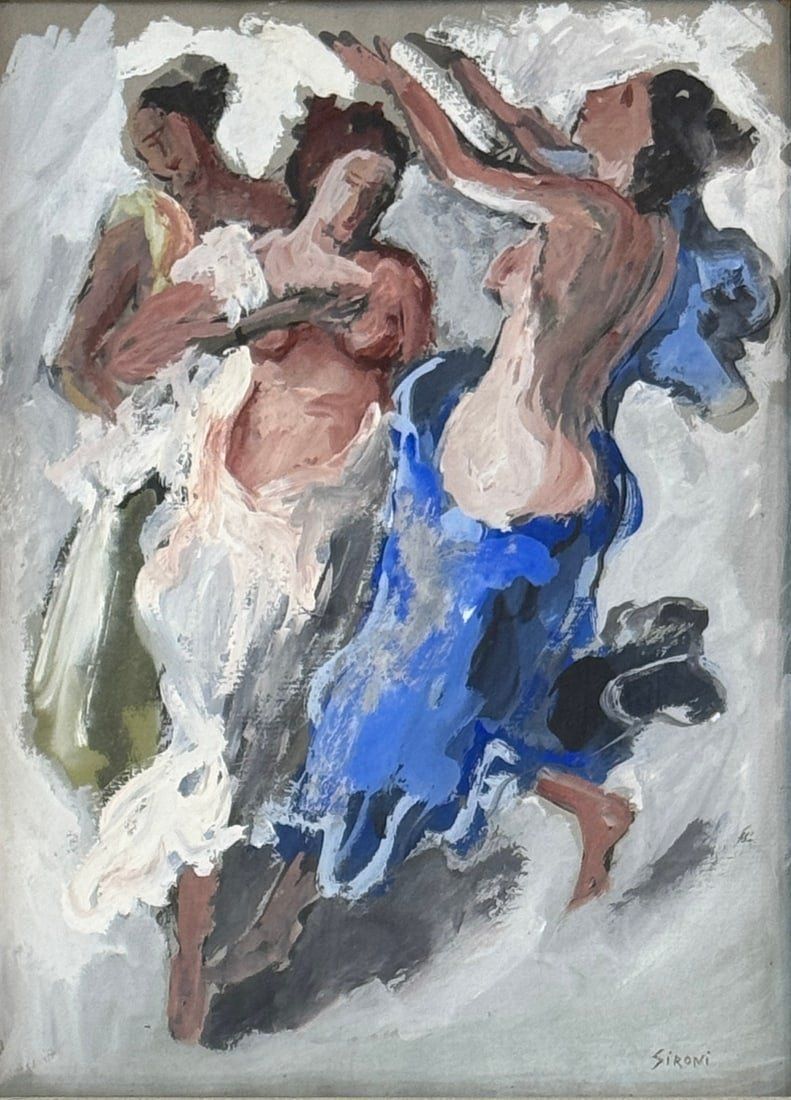
Bidspirit auction | Sironi (1885-1961) Italy
Sironi (1885-1961) Italy - Mario Sironi (1885-1961) Gouache on paper, signed lower right ”Sironi”, piece measures 13.5 x 10.5 and 15 x 19 inches w/ frame. Sarasota, Florida Estate. Although born in Sassari, Mario Sironi was raised in Rome. In the Italian capital he left his studies to study art at Scuola Libera del Nudo. In this same period he frequented the studio of Giacomo Balla and met Boccioni and Severini. The latter introduced him to Divisionism, which he developed in a very unique way. He adhered fully to futurism and the interventional choices related to the movement, participating in the First World War. Among his pictorial themes, he introduced that of the suburbs with a strong sense of desolation observing metaphysical tendencies. His work as an illustrator, which he had continued simultaneously, intensified when he collaborated in the questionnaire Il Popolo d’Italia, the organ of the National Fascist Party, making powerfully concise vignettes, book covers and caricatures.As he did with Divisionism, he provided a quite original interpretation of the Futurist style, proposing a particular attention addressed to the use of volume. This aspect had not been explored before by the other artists.In 1919, he moved to Rome again and there he had his first solo exhibition at the Casa d’Arte Bragaglia. He later on moved to Milan, where in 1922 he founded Il Gruppo dei Pittori del ‘900, with fellow artists Bucci, Dudreville, Funi, Malerba, Marussig and Oppi. This group of seven artists had the first exhibition in 1923 in Milan at the Galleria Pesaro.Meanwhile, the painter was becoming increasingly active in the cultural politics of fascism. Consistent with the aspirations of a global practice of the arts, Sironi engaged in the design of displays for exhibitions, creating stained glass windows. He dedicated himself to murals, mosaic and sculpture. With the outbreak of the Second World War, he returned to easel painting, with a renewed relationship of immediacy with the surface of the painting and with a new emotional component.In 1932, the Quadriennale of Rome dedicated a whole personal room to Sironi. After the Second World War he refused to participate to the Venice Biennale, but continued to exhibit at the Triennale in Milan and the Quadriennale in Rome. In 1956 he was elected scholar of San Luca. He died in 1961 in Milan. Condition: The absence of a condition report does not imply an object is free of defects. All items may have normal signs of age and wear commensurate with their age; these issues will likely not be mentioned in the condition report. Please contact the auction house before the auction with any condition questions. Questions about condition will not be answered after purchase. Condition reports are provided as a courtesy, and we are not responsible for any errors or omissions. Important note on frames: Frames are not guaranteed to be in the same condition as they are in the item photograph. Due to handling and shipping, many frames, especially antique ones, are prone to losses. If you have questions about the condition of a frame, please contact us prior to the auction.