Bidspirit auction | Emile Galle Marquetry Tripod Side
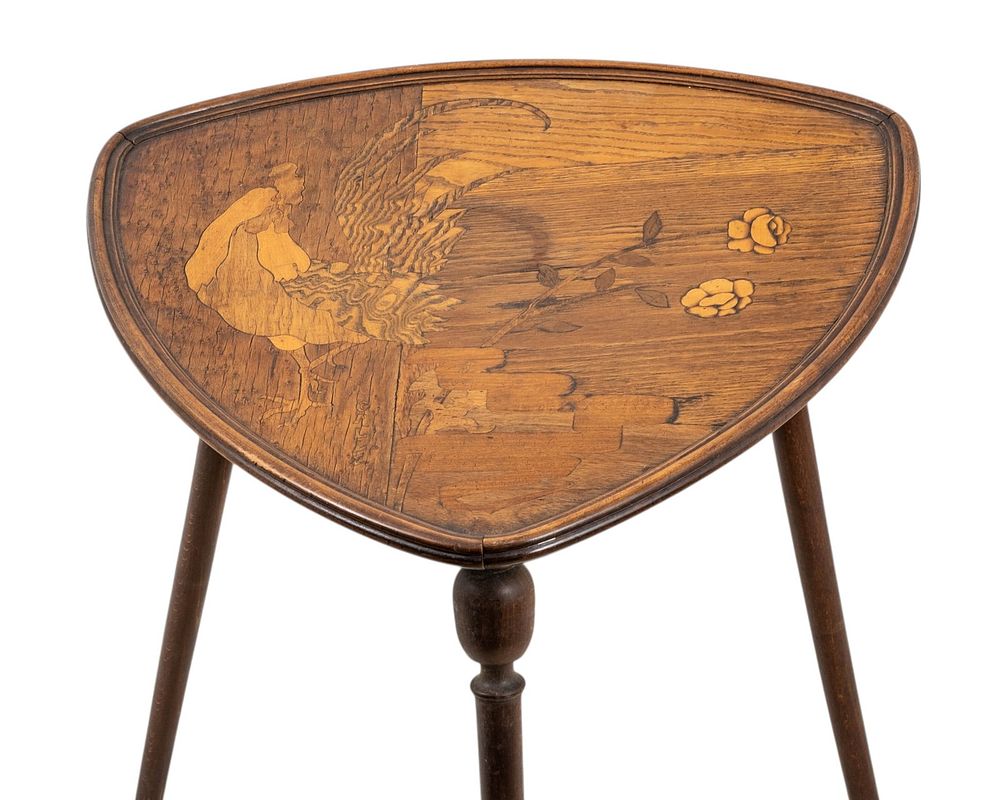
Emile Galle Marquetry Tripod Side Table, Signed, Art Nouveau, Nancy, Late 19th Century - Keywords: Art Nouveau furniture, École de Nancy, inlaid wood table, marquetry side table, tripod table, French decorative arts, tavolo table, occasional table Summary: French Art Nouveau Table by Émile Gallé, Shield-Shaped Top with Rooster and Rose Marquetry, Nancy School, Signed Bio: Émile Gallé (1846–1904), born and based in Nancy, France. A leading figure of French Art Nouveau, he trained in glassmaking, ceramics, and botany before taking over his family's business and expanding into furniture in 1885. His furniture combined Rococo-inspired forms with naturalistic marquetry — florals, insects, and birds — often signed ”Gallé” directly in the inlay. In 1901 he founded and led the École de Nancy, the movement's central organization (Wikipedia, Britannica). Measurements: 28 x 21 x 21 1/2 in. (71.1 x 53.3 x 54.6 cm.) approx Condition: Bidders are encouraged to carefully review all photographs and, when possible, examine items in person prior to bidding. Photographs form an integral part of each lot’s description. The absence of a condition report, notation, or reference to damage does not imply that an item is free from defects, restoration, wear, or other condition issues. All items are sold as is, where is, and may show signs of age, use, wear, repair, or prior restoration. By placing a bid, bidders acknowledge and agree to the Terms and Conditions of Sale. All descriptions, catalog statements, condition reports, reflect an opinion based on the information provided to us at the time of cataloging. Any certificates of authenticity, if provided by consignor, will be noted in the catalog. Clocks and watches are not warranted or represented to keep accurate time. We strongly recommend that all vintage lighting be examined or rewired prior to use. Auction Galleries reselling works do not issue Certificates of Authenticity. COA's should best be sought from the original artist or their foundations, which often refrain from giving written authentication opinions. Accordingly, works are sold as ATTRIBUTED to the artist or maker named in the description. These attributions reflect an OPINION and are intended to provide collectors, researchers, and institutions the opportunity to study and further contextualize the material offered or establish a work’s art-historical significance.