Bidspirit auction | Johann Heinrich Roos, 'Ideal Landscapes
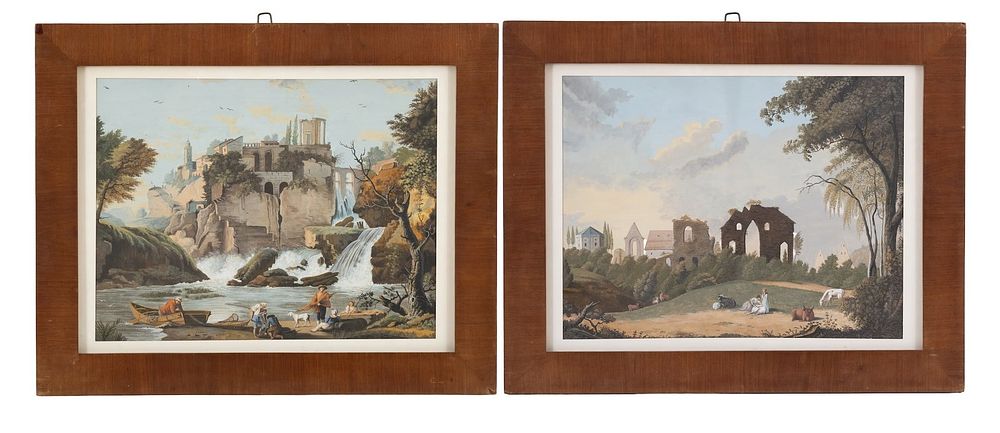
Johann Heinrich Roos, 'Ideal Landscapes with Ruins' Pair of Gouache Paintings - No Reserve - Keywords: German Old Master, Gouache, Pair, Pastoral Landscape, Ideal Landscape, Italianate Landscape, Architectural Ruins, Ancient Ruins, Pastoral Idyll, Herdsmen, Livestock, Cattle, Classical Landscape, Campagna, Rome, 17th Century, Baroque, German Baroque, Old Master, Landes Museum Hannover, Museum Provenance Summary: Johann Heinrich Roos (German, 1631–1685), pair of gouache paintings depicting idealized pastoral landscapes with architectural ruins. One composition depicts a dramatic rocky landscape with cascading waterfalls, classical architecture, figures, animals and a boat in the foreground; the second depicts a pastoral landscape with figures and livestock before extensive ruins and distant architecture. The works are accompanied by an original signed letter dated December 3, 1937, from the Director of the Art Department of the Landes-Museum Hannover. The letter concerns these two gouaches by Roos and explains that the works, which had been left with the museum for examination and subsequently could not be located, had finally been rediscovered after a number of years in the museum’s Prehistoric Department. The director apologizes for the circumstances and states that the pictures were again available to their owner. The original 1937 museum letter accompanies the lot. The paintings have not been removed from their frames or matting for examination, and the framing was not disturbed to search for or examine possible signatures. Johann Heinrich Roos was particularly known for pastoral idylls depicting herdsmen and livestock within idealized southern and Italianate landscapes, frequently incorporating ancient ruins, rocks, trees, streams and distant hills. More than 200 works of this type are known, dating from approximately 1657–58 through the end of his career. Roos drew upon engraved sources for elements of the Roman Campagna and classical monuments, including Roman temples and the Ponte Molle. His pastoral compositions often explore a harmonious relationship between figures, animals and the natural landscape, a theme that developed in European art in the period following the Thirty Years’ War. In several works, Roos also incorporated himself or portrait subjects in the guise of herdsmen. Works by Johann Heinrich Roos are represented in numerous institutional collections, including the Kunsthistorisches Museum, Vienna; Fine Arts Museums of San Francisco; Detroit Institute of Arts; Dulwich Picture Gallery, London; Crocker Art Museum; Indianapolis Museum of Art; Dallas Museum of Art; and Palazzo Bianco, Genoa, among others. Provenance/Documentation: Accompanied by the original December 3, 1937 signed correspondence from the Landes-Museum Hannover concerning the two Roos gouaches and their rediscovery within the museum. This is a NO RESERVE lot. There are no hidden or confidential reserves. All acceptable bidding begins at the published online START PRICE. Measurement: Visible: 12 1/2 x 16 1/4 in. (31.8 x 41.3 cm.), Frame: 18 x 22 1/4 in. (45.7 x 56.5 cm.) approx Condition: Bidders are encouraged to carefully review all photographs and, when possible, examine items in person prior to bidding. Photographs form an integral part of each lot's description. The absence of a condition report, notation, or reference to damage does not imply that an item is free from defects, restoration, wear, or other condition issues. All items are sold as is, where is, and may show signs of age, use, wear, repair, or prior restoration. By placing a bid, bidders acknowledge and agree to the Terms and Conditions of Sale. All descriptions, catalog statements, condition reports, reflect an opinion based on the information provided to us at the time of cataloging. Any certificates of authenticity, if provided by consignor, will be noted in the catalog. Clocks and watches are not warranted or represented to keep accurate time. We strongly recommend that all vintage lighting be examined or rewired prior to use. Auction Galleries reselling works do not issue Certificates of Authenticity. COA's should best be sought from the original artist or their foundations, which often refrain from giving written authentication opinions. Accordingly, works are sold as ATTRIBUTED to the artist or maker named in the description. These attributions reflect an OPINION and are intended to provide collectors, researchers, and institutions the opportunity to study and further contextualize the material offered or establish a work's art-historical significance.