Bidspirit auction | WWII Major General Livesay 91st
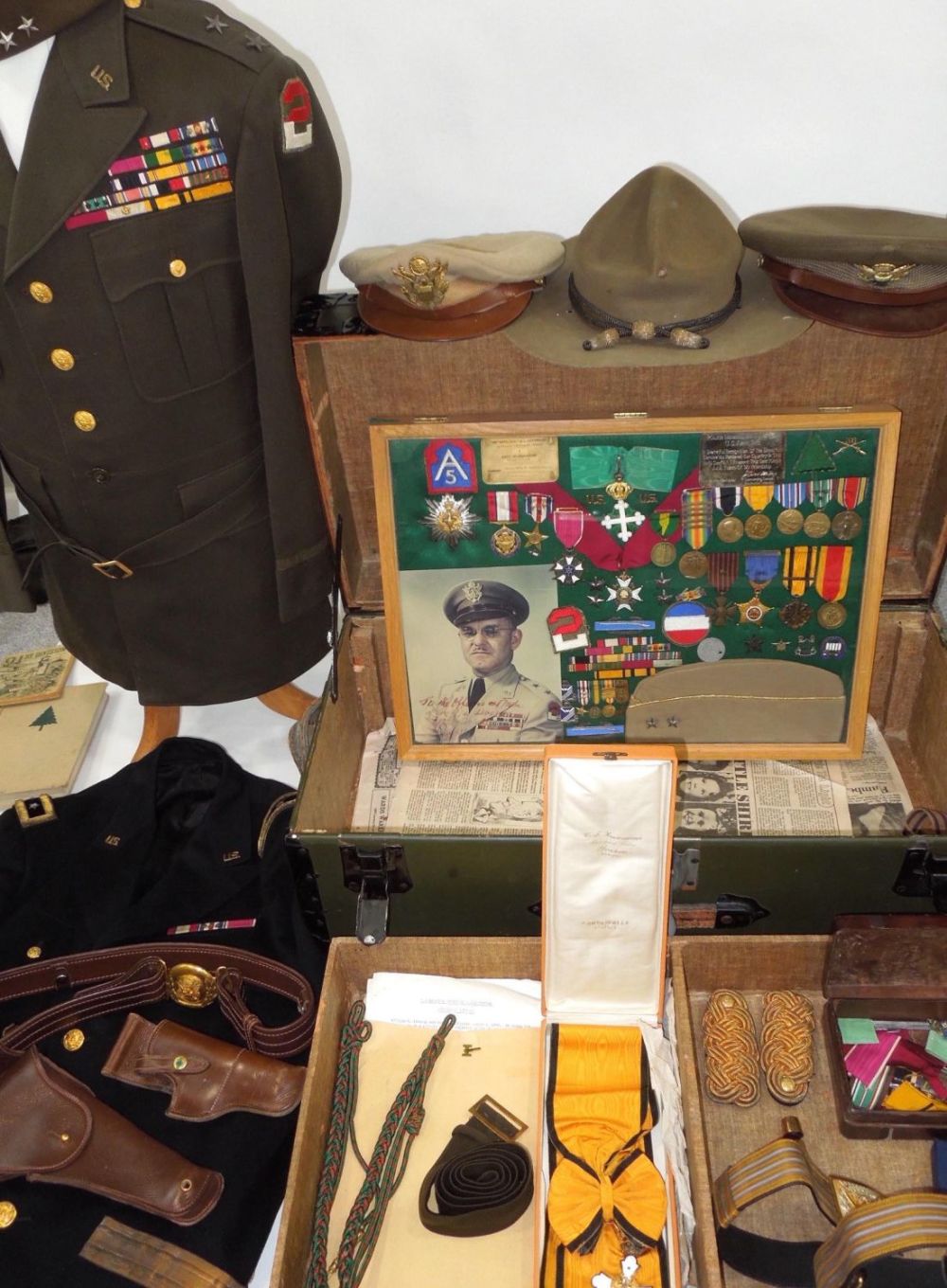
WWII Major General Livesay 91st Div. Archive- Uniforms, Medals, Footlocker - An extensive and remarkably complete group of uniforms, medals, and memorabilia of a noted World War II combat General and Division Commander: Major General William Livesay. William Livesay began his military service as an enlisted man, joining the Regular Army on May 3 of 1915. In a career that would span more than three decades, General Livesay would serve with marked valor in combat in two world wars, command a U.S. Army division in some of the most ferocious fighting of the modern era, and assist a critical American ally in preserving its democratic government during the tumultuous Cold War. He would be recognized for his wartime courage and for his indomitable leadership with some of the most significant military medals and decorations that could be bestowed by the United States Army and by foreign governments. After joining the army in 1915, Livesay served as an enlisted man with the 19th Infantry Regiment (the ”Rock of Chickamauga”) on the Mexican Border. He rose to the rank of corporal, at which point his leadership abilities were clearly recognized and, despite the small size and the meager resources of the peacetime army, Livesay was selected for officer training. He was commissioned as a 2nd Lieutenant of Infantry in November of 1916 and he then attended the first officers class at Fort Leavenworth, Kansas, in early 1917. With the entry of the United States into World War I, Livesay was with the first contingent of American troops to arrive in France in June of 1917. He served as an infantry officer with the 28th Infantry Regiment of the 1st Infantry Division. For his valor in action he would receive three Silver Stars: for exceptional courage at Cantigny, France, in May of 1918; an oak leaf cluster for a second award of the Silver Star for valor at Exermont, France, on 5 October 1918; and a second oak leaf cluster, reflecting a remarkable third award of the Silver Star, for gallantry at Meuse-Argonne, on 11 October, 1918. He also was awarded the French Croix de Guerre with bronze star. Following the war Livesay held a number of key assignments, including attendance at the Command and General Staff School in 1925; Instructor at the Army Infantry School in 1926; attendance at the Army War College in 1932; and service in the Office of the Chief of Infantry in 1936. When the Second World War broke out, Livesay was serving as Chief of Staff of the Puerto Rican Department (for which he was awarded a Legion of Merit), when he was recalled to the continental United Sates and, after serving briefly as Assistant Divisional Commander of the 35th Division, he was made the Commanding General of the 91st Infantry Division. In that role he led the division to war in Europe and was one of the relatively few World War II Army Divisional Commanders to retain command of his division from its entry into combat until victory in Europe. The 91st Division would see some of the fiercest fighting of the war as it fought its way up the Italian peninsula, being awarded the North Apennines, Po Valley and Rome-Arno campaign streamers. For his valor in action, and for his aggressive leadership of this hard-fighting division, Livesay was awarded a fourth Silver Star (for gallantry in action at Vicenza, Italy on 28 April, 1945) and a Distinguished Service Medal, as well as being made a Commander of the Order of St. Lazarus of Italy and a Commander of the Order of the Bath of Great Britain. Following the Second World War the liberated nations of Europe faced the very real danger of subversion of their new, democratic governments, by agents of communist insurrection. In June of 1947 Livesay arrived in Greece as Commander of the U.S. Army Advisory Group, with the mission to assist the democratic Greek government in defeating attempts that were being made to overthrow or subvert it. In this he was successful, and he was awarded the Medal of Military Merit of Greece and the Grand Cross of the Order of the Phoenix by the Greek government. General Livesay returned to the United States and in 1948 became the Commanding General at Fort Knox, following which he retired from military service. This grouping of General Livesay's material includes the following items: General Livesay's belted, four pocket olive green officer tunic, WWII dated on the tag, with two sterling pin back stars on each shoulder, a Second Army patch on the left shoulder and a 91st Division patch on the right shoulder, and clutch back ribbon bars for the following medals and decorations: Distinguished Service Medal; Silver Star with 3 oak leaf clusters; Legion of Merit; Mexican Border Medal; World War I Victory Medal with 5 campaign stars; World War I Army of Occupation Medal; American Defense Medal; American Campaign Medal; European Campaign Medal with 3 campaign stars; World War II Victory Medal; World War II Army of Occupation Medal; French Croix de Guerre with bronze star;