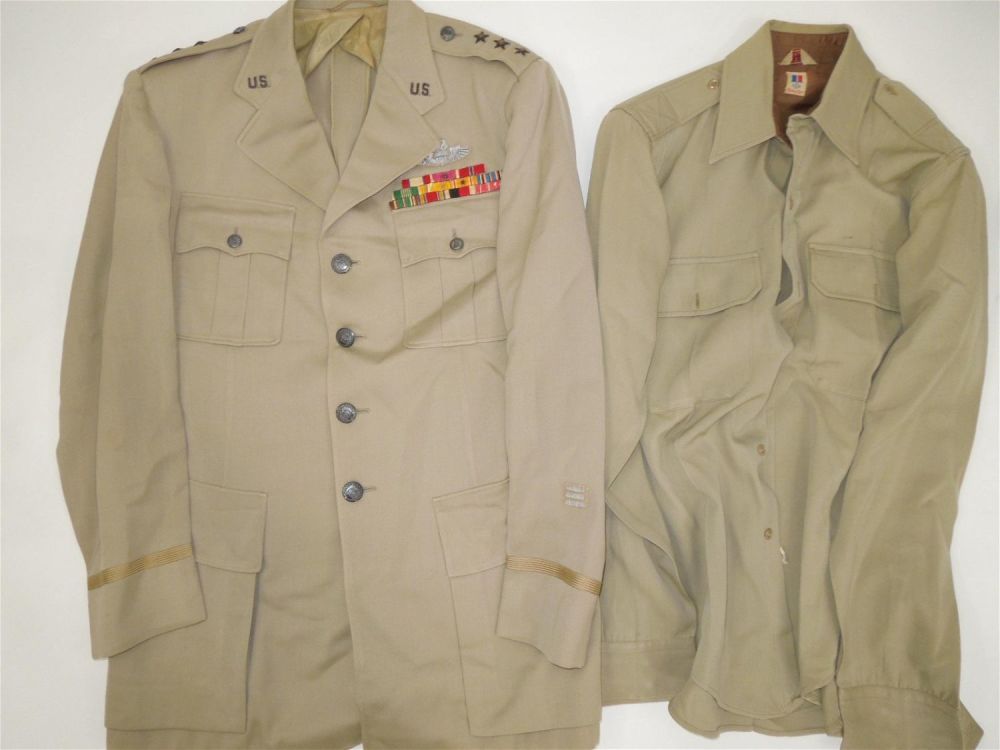
Bidspirit auction | 1960s USAF Air Force Named
1960s USAF Air Force Named Lt. General Uniform WWII Vet Silver Tans - Great 1950's silver tans uniform to Lieutenant General Richard Clark Lindsay. Sewn ribbons, bullion wings, US and direct embroidered stars. Named inside, and comes with matching shirt. Richard Clark Lindsay was born in Minneapolis, Minn., on Oct. 31, 1905. He graduated from West High School in 1924 and attended Carlton College and the University of Minnesota. On June 11, 1928 he was appointed a second lieutenant in the infantry reserve and on June 28 he enlisted as a flying cadet in the Army Air Corps. During his cadet period he attended the Primary and Basic Flying School at March Field, Calif., and graduated in June 1929 from the Advanced Flying School at Kelly Field, Texas. He was commissioned a second lieutenant in the air reserve upon graduation from Kelly and as a second lieutenant in the Regular Army Air Corps on Sept. 14, 1929. Lieutenant Lindsay's first assignment was to the 91st Observation Squadron at Crissy Field, Calif. He served on temporary duty at Mather Field, Calif., during the first provisional wing maneuvers at that station from April through May of 1930, performing various duties in the Support Squadron. In October 1930 he entered the Air Corps Tactical School, Maintenance Engineering Course, at Chanute Field, Ill. He graduated the following June and was reassigned to Crissy Field where he rejoined the 91st Observation Squadron, serving first as assistant and later as squadron engineering officer. In January 1934 Lieutenant Lindsay entered the course in Advanced Aerial Navigation at Rockwell Field, Coronado, Calif. This course was interrupted when the U.S. Army Corps was designated to handle the airmail and he served as a pilot flying the mail on Route 5, between Portland, Ore.; Pasco, Wash; and Boise, Idaho, in the Western Zone of the United States. In July 1934 after completing numerous flights and acting as station control officer at Pasco, Wash., he returned to the 91st Observation Squadron at Crissy Field. Lieutenant Lindsay returned to Rockwell Field in October and completed the Advanced Navigation Course in November. In May of 1935 he was transferred to Hamilton Field, Calif., where he served with the 9th Bomber Squadron and the 88th Observation Squadron (long-range) as navigation officer. In January 1937 he found himself in Hawaii where he served in the 7th Service Squadron at Schofield Barracks, the 50th Observation Squadron at Luke Field, and the 18th Wing at Hickam Field. While at Luke Field he served in navigation and operations staff assignments and during this period conducted a navigation school for selected officers in the Hawaiian Department. In late 1938 and early 1939 he served first as operations officer and then as assistant operations officer of the 18th Wing at Hickam Field. He then returned to the United States in April of 1939 and was assigned to the 97th Observation Squadron at Mitchel Field, N.Y. While stationed at Mitchel he attended the Air Corps Tactical School at Maxwell Field in January through March of 1940. He then rejoined the 97th while it was on maneuvers with the Fourth Provisional Observation Group at Natchitoches, La. After his tour with the 97th Observation Squadron, during which time he received his promotion to captain, he was assigned to the 22nd Observation Squadron at Brooks Field, Texas, where he conducted a course training combat observers. In March of 1941 the combat observer training was turned over to the Advanced Flying School at Brooks Field and the now Major Lindsay became chief of Section III and later the director of the Ground School and assistant director of training. In November 1941 Major Lindsay joined the War Department General Staff where he was first assigned to the Air Plans Division, serving as member of, and later as the chief of, the African-Middle East Section, where he received his promotion to lieutenant colonel. Then, upon the reorganization of the War Department in March 1942, he served as a member of, and later as chief of the Policy Division of the Strategy and Policy Group in the Operations Division. In the summer of 1942 he was made a temporary colonel in the Army Air Forces. In June 1943 he was assigned to the Joint War Plans Committee where he participated in the preparation of strategic studies utilized by the joint and combined chief of staff in determining the operations the allies would undertake in the pursuit of the war. In August 1944 he became chief of the Combined Joint Staff Division of the Headquarters Army Air Forces and was promoted to the grade of brigadier general. At the time he served as the Army Air Forces representative on the Joint Staff Planners of the Joint Chiefs of Staff. In May 1945, after his return from Europe, General Lindsay was assigned to the Twentieth Air Force directing the B-29 operations against Japan and in July was transferred from Pentagon duty to the Headquarters U.S.