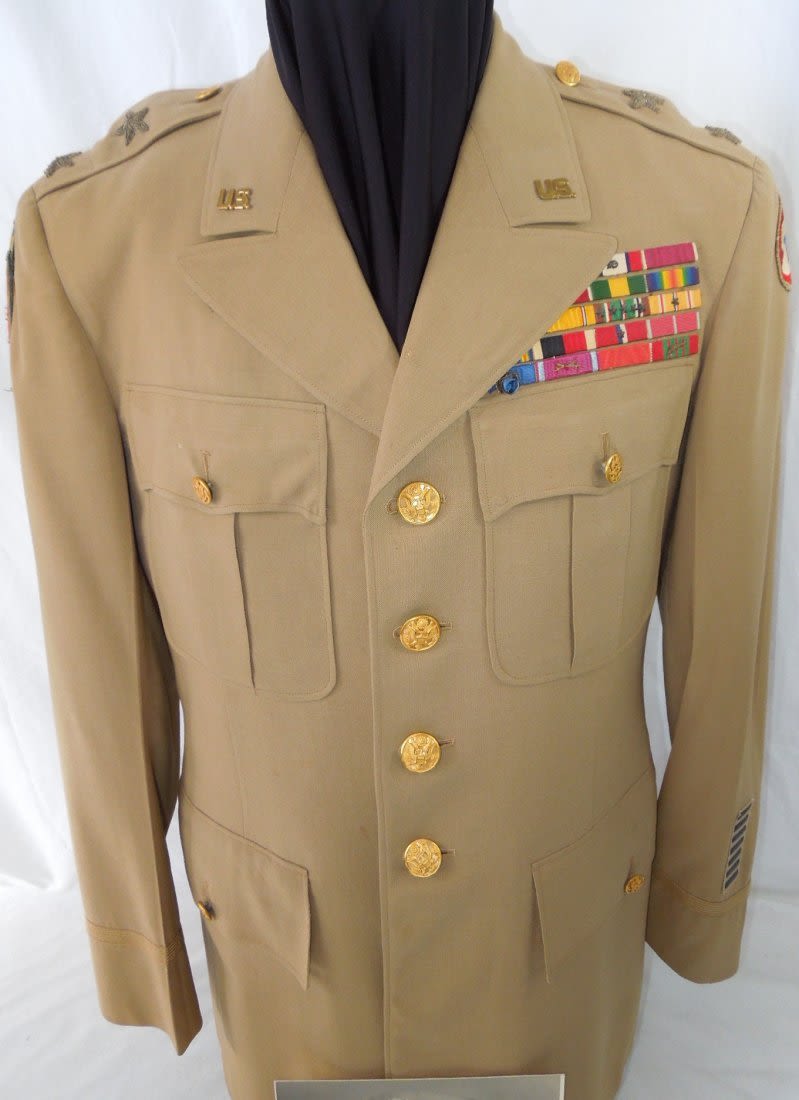
Bidspirit auction | WWII Major General Ewart Plank
WWII Major General Ewart Plank ADSEC Uniform - Uniform jacket of Major General Ewart Gladstone Plank. Sewn ribbons, bullion rank stars, no name on a label anywhere. Comes with autographed photo and research. November 1897 - 2 September 1982) was a United States Army career officer who was a veteran of World War I and World War II. A graduate of the United States Military Academy at West Point, New York, he was ranked 44th in the class of 1920. He was commissioned in the Coast Artillery Corps, but later transferred to the Corps of Engineers. During World War II he commanded the Advance Section, Communications Zone (ADSEC). He entered the University of Kansas in 1915, and joined the Kansas National Guard. In 1917, he was called to active duty for World War I, and served in the ranks in France with the 137th Infantry Regiment, part of the 35th Division. However, he returned to the United States on being appointed to the United States Military Academy at West Point, New York, which he entered on 17 June 1918. He became an editor of the annual yearbook, The Howitzer. The class of 1920 was initially supposed to graduate after one year, but the end of the war led to it being extended. The class was given the option of graduating after three years instead of just two. None did however, and the entire class graduated on 15 June 1920. He was commissioned as a second lieutenant in the Coast Artillery Corps on 2 July 1920, and promoted to first lieutenant the same day. Plank transferred to the Corps of Engineers on 4 September 1920. He attended the Engineer Officer Basic Course at Camp A. A. Humphreys, Virginia, from 15 September 1920 to 27 January 1921, and was then posted to the 2nd Engineer Regiment at Camp Travis, Texas. He attended the Engineer School at Rensselaer Polytechnic Institute from 1 June 1921 to 18 June 1922, where he studied civil engineering. He was assigned to McCook Field, Ohio, where he was involved in aerial survey and mapping. If any members of the class of 1920 thought that things could not get worse, they were wrong; on 15 December 1922, the whole class was demoted to the rank of second lieutenant. On 28 March 1925, Plank was promoted to first lieutenant again. He attended the Air Corps Primary Flying School at Brooks Field, Texas, from 15 September 1926 to 28 February 1927, when he was graduated, and then the Air Corps Advanced Flying School at Kelly Field, Texas, from 28 February to 17 May 1927. He returned to the 2nd Engineers, which was now located at Fort Sam Houston, Texas, but moved to Fort Logan, Colorado on 5 August 1927. His next assignment was with the 11th Engineer Regiment in the Panama Canal Zone, and he was involved in survey work in Nicaragua. He married Doris Reed from Denver at Corozal in the Panama Canal Zone on 2 December 1927. They had one child, a daughter, Jacqueline, who was born in 1935. Returning to the United States in 1930, Plank was assigned to the Office of the District Engineer at Vicksburg, Mississippi from 2 October 1930 to 2 August 1931. He then became an instructor with the 120th Engineer Regiment, a New Mexico National Guard unit based at Las Cruces, New Mexico. On 7 January 1934, he joined the Office of the District Engineer at Fort Peck, Montana. After fifteen years as a lieutenant, he was promoted to captain on 1 August 1935. Between 1 September 1939 and 4 February 1940, Plank attended the Command and General Staff College at Fort Leavenworth, Kansas. He then commanded the Topographic Company at Fort Benning, Georgia, where he was promoted to major on 1 July 1940. On 22 December 1940, he became the head of the National Defense Projects Branch in the Office of the Chief of Engineers in Washington, DC. As such, he was responsible for the airbase construction program, which had recently been transferred to the Corps of Engineers from the Quartermaster Corps. Major Henry F. Hannis, a fellow member of the class of 1920 and a fellow graduate of Rensselaer Polytechnic Institute, served as the liaison with the United States Army Air Corps. ”When we took over the air force construction from the Quartermaster, it was just simple chaos, ” Plank later noted. The Quartermaster Corps handed over blueprints and designs for airbases, but not basic engineering data and criteria for the design of paved runways, and designs for specialized Air Corps facilities was often lacking. Plank had to build a new organization from scratch; it grew to a hundred people in six months. The effort was made possible through decentralization, with Plank leveraging the Corps of Engineers' division and district offices, who were given permission to approve contracts of up to $500,000 and $100,000 respectively. The head of the Air Corps' Building and Grounds Division, Colonel Frank M. Kennedy, had a policy of accepting tracts of land donated by local authorities for airbase construction. ”How old do you have to be, ” Plank asked rhetorically,