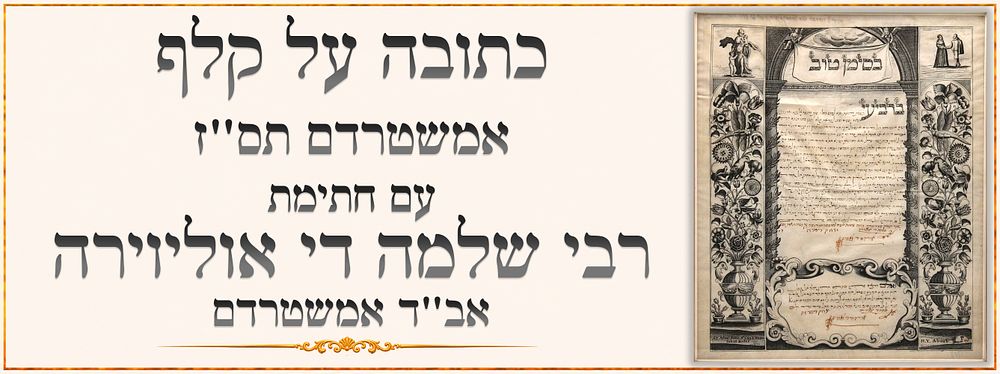
Bidspirit auction | Important Early Parchment Ketubah –
Important Early Parchment Ketubah – Amsterdam, 1706 – Signed by Rabbi Shlomo de Oliveira. - Ketubah for the marriage of the groom, Yitzchak son of Avraham de Miza, and the bride, Sarah daughter of Aharon de Pinto. Signed by the presiding rabbi, Rabbi Shlomo de Oliveira; Abraham de Chaves; and the groom. Amsterdam, 4 Kislev 1706. At the foot of the ketubah, the parties undertake to uphold the “conditions agreed upon between them ... recorded in the book of the aforementioned city notary, Dirck van der Graaf.” The presiding rabbi, Rabbi Shlomo de Oliveira, Abraham de Chaves, and the groom, Yitzchak de Miza, sign once again beneath this declaration. The text of the ketubah and its accompanying tena’im (marriage conditions) is handwritten in Sephardic script on an especially fine, thin, light-colored parchment sheet, surrounded by an elegantly engraved copperplate border, printed with remarkable clarity and precision. On either side of the border are large floral arrangements rising from vases, adorned with birds and various animals. Above them appear a bride and groom in period dress (right), and a mother with her two children (left), an allegorical representation of Charity (Caritas). The inner frame features two rounded columns, decorated with foliage and supporting an arch. On either side of the arch are two cherubs holding a banner bearing the inscription “B’Siman Tov” (“As a Good Omen”). The word “Wednesday” (B’Revi’i) is also printed as part of the engraving. The lower portion contains a large cartouche intended for recording the dowry arrangements. At the bottom, on either side of the engraving, appear the name of Rabbi Yitzchak Aboab and the date of his passing. The engraving is unsigned. It is generally believed that the border decorations were inspired by designs previously created by the artist and copperplate engraver Shalom Italia for two earlier Dutch ketubot: one from Rotterdam, 1648 (formerly in the Moses Heyman Gans Collection and now in the Israel Museum, item B51.04.0257), and another from Amsterdam, 1654 (Etz Chaim Library Collection, Amsterdam, Pl. 1, Catalogue no. 385). Shalom, son of the honorable Mordechai Italia (also known as Shalom d’Italia or Italia), arrived in the Netherlands from Mantua. He was particularly renowned for creating and decorating Esther scrolls, as well as for his portraits of Jacob Judah Leon and Menasseh ben Israel. He died around 1655, and it may be assumed that, following his death, the ketubot he had engraved served as inspiration and models for the creation of the present ketubah design. This style of ketubah, which originated around 1660, remained in use among the Sephardic-Portuguese communities of the Netherlands for many years, in slightly varying versions and with differing levels of printing quality and finish, throughout the eighteenth century and into the mid-nineteenth century. The Gaon and Hakham Rabbi Shlomo ben David de Oliveira, Rabbi of Amsterdam [c. 1635–1708], was descended from a family of conversos from Lisbon. He studied under Rabbi Menasseh ben Israel and Rabbi Shaul Mortera. Following the passing of the Gaon Rabbi Yaakov Sasportas in 1698, Rabbi Shlomo de Oliveira was appointed head of the rabbinical court of Amsterdam’s Sephardic-Portuguese community and head of the Etz Chaim Yeshiva. During his tenure, the practice began of yeshiva students composing written questions and responsa. This initiative eventually developed into the periodical Pri Etz Chaim, first published in 1728. Rabbi Shlomo de Oliveira passed away in 1708, and was succeeded as rabbi of the community by the Gaon Rabbi Shlomo Ayllion. A prolific author, he composed numerous works, several of them fundamental studies, on Talmudic principles, the cantillation of Scripture, and other subjects. Among his works are Eilat Ahavim, Darkhei Hashem, Darkhei Noam, Zayit Ra’anan, Ta’amei HaTe’amim, and Etz Chaim, among many others. He also provided approbations for books by his contemporaries. The Chida mentions several of his works, for example: “Ta’amei HaTe’amim was arranged and composed by the esteemed Rabbi Shlomo de Oliveira, one of the rabbis of the Sephardic community of Amsterdam” (Shem HaGedolim, Works, letter Tet). A number of Talmudic principles widely cited today appear for the first time in Rabbi Shlomo de Oliveira’s work on the principles of the Talmud. One example distinguishes between the formulations “Rabbi So-and-so says” and “Rabbi So-and-so said”: the former indicates that the sage disagrees with the preceding authority, whereas the latter does not. This principle appears in his Darkhei Noam and is cited in his name by later authors. See: Solomon de Oliveyra: A Seventeenth Century Sephardic Sage by Marvin J. Heller. https://www.sephardichorizons.org/Volume13/Issue1/Heller.html The bride’s father, “the venerable elderly and distinguished Rabbi Aharon de Pinto” (as he is described in the ketubah),