Bidspirit auction | Two Works by Menasseh ben
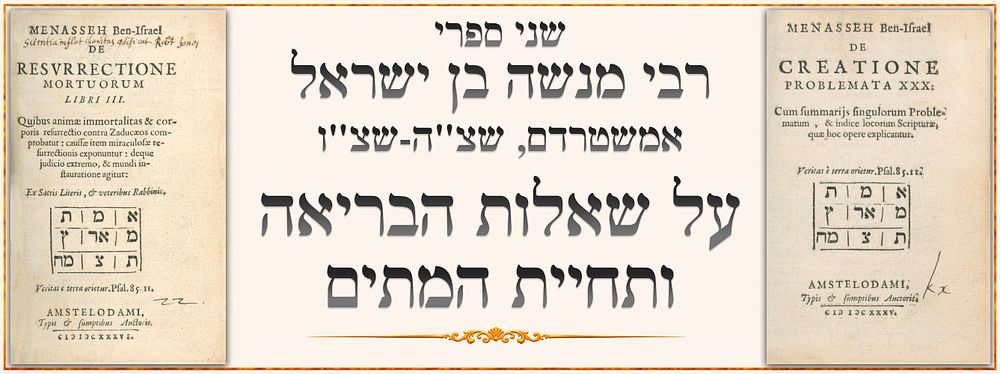
Two Works by Menasseh ben Israel – Amsterdam, 1635–1636 – On the Creation of the World and the Resurrection of the Dead. - 1. De Creatione Problemata XXX (Thirty Questions on the Creation of the World), by Menasseh ben Israel. Typis & sumptibus auctoris (printed and published by the author). Amsterdam, 1635. First edition. Latin, Spanish, and some Hebrew. First edition of Menasseh ben Israel’s important work on the Creation, printed at the author’s own press in Amsterdam. At the beginning of the volume are five poems addressed to the author, including works by Caspar Barlaeus, Emanuel Nehemias, Jonah Abarbanel, and Moses Pinto. [16], 156, [2] pp. 14 cm. 2. De resurrectione mortuorum libri III. Quibus animae immortalitas & corporis resurrectio contra Zaducaeos comprobatur. Caussae item miraculosae resurrectionis exponuntur. Deque judicio extremo, & mundi instauratione agitur. Ex sacris Literis, & veteribus Rabbinis. Amstelodami: Typis & sumptibus Auctoris, 1636. On the Resurrection of the Dead is a 17th-century work by Menasseh ben Israel defending traditional rabbinic views of immortality of the soul, reincarnation, and resurrection, in light of challenges posed by skeptics. Rabbi Ben Israel self-published the work using the printing press he established in Amsterdam. On the Resurrection of the Dead was originally published in Judeo-Spanish, and was published again in Latin the same year. First Latin edition, author-imprint issue. [24], 346, [6] Pp. 14 cm. Silva Rosa 25 and 21. On both title pages appears the printer’s device: a square divided into nine smaller squares, containing the letters of the biblical phrase “Truth shall spring forth from the earth” (Emet Me’eretz Titzmach), arranged so that the verse can be read both from right to left and from top to bottom. The Amsterdam Jewish community at this time was comprised primarily of Marranos, who in their Iberian homeland knew Judaism, if at all, only through the lens of the Old Testament. Since the doctrine of the resurrection of the dead is not elucidated in the Bible, many of the newly arrived Marranos came to doubt the belief in an After-life. In response to these skeptics (especially Uriel Acosta), Menasseh marshalled proofs from throughout Judaic literature as to the existence of a world to come. The second work, was the first of Menasseh's philosophical texts, dealing with the Jewish notion of creatio ex nihilo. Following in the footsteps of Maimonides, Menasseh sought to disprove the Aristotelian notion of the pre-eternity of the world. See C. Roth, A Life of Menasseh ben Israel (1945) pp. 91-4. Rabbi Menasseh ben Israel (1604–1657) was a rabbi, preacher, and statesman, born in France to a family of Portuguese conversos. He established the first Hebrew printing press in Amsterdam and was renowned for his mastery of languages and secular learning. He devoted considerable efforts to the welfare of Jewish communities throughout the Diaspora. In 1655, a conference convened in England under the leadership of Oliver Cromwell to discuss the right of Jews to return to the kingdom. Menasseh was invited by Cromwell to participate in the deliberations as a representative of the Jewish community. He is credited with playing a decisive role in the re-establishment of a Jewish community in England, following the expulsion of the Jews from the kingdom by order of King Edward I.