Bidspirit auction | Signature & Autograph Glosses by
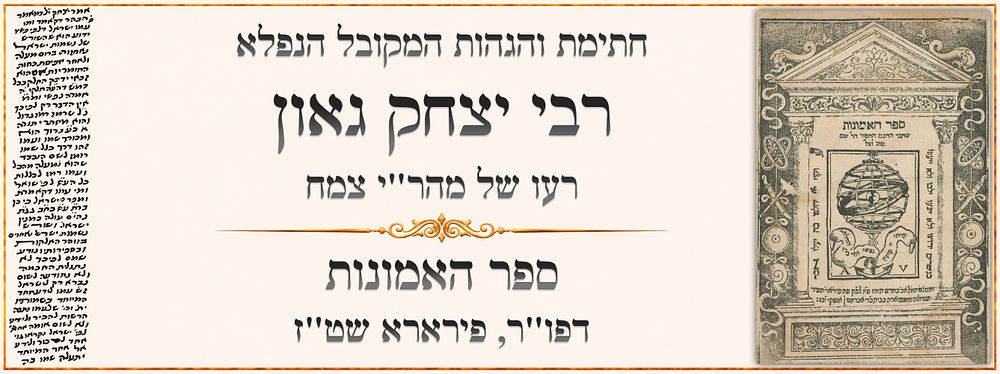
Signature & Autograph Glosses by the Remarkable Kabbalist Rabbi Yitzchak Gaon of Jerusalem, Colleague of Rabbi Yaakov Tzemach. Sefer Ha-Emunot by Rabbi Shem Tov ibn Shem Tov. First Edition, Ferrara 1556. - Sefer Ha-Emunot by Rabbi Shem Tov ibn Shem Tov. A treatise on matters of faith and theology, expressing the author's opposition to philosophical rationalism. Only Edition. Ferrara, 1556. Printed by Abraham Usque. Several lines of text and the signature of the renowned Gaon and Kabbalist Rabbi Yitzchak Gaon of Jerusalem appear at the end of the volume. The margins throughout contain lengthy and important glosses in his own holy handwriting. The gloss on fol. 32b begins with the words: “Amar Yitzchak” (“Yitzchak says”). A Fundamental Work on the Principles of Faith Sefer Ha-Emunot is a fundamental treatise on the foundations of Jewish faith, authored by Rabbi Shem Tov ibn Shem Tov. The author's purpose was to establish that faith must rest upon wholehearted belief, rather than upon the approach of those who follow philosophy and seek to ground their convictions exclusively in philosophical inquiry. In his introduction, he writes that many who based their faith upon philosophical reasoning ultimately fell into heresy and converted to other religions. This approach is cited by the holy Shelah, Rabbi Isaiah Horowitz, who writes: “The pious Rabbi Shem Tov, in the introduction to his Sefer Ha-Emunot, took issue with the philosophers among our people, censuring their idle talk. At the conclusion of his remarks, he stated: ‘When I examined their words, a flame kindled within me, for I saw that a malignant leprosy had spread among the Children of Israel. I observed that throughout these generations, those who excelled in philosophical inquiry had denied the faith and converted.’” )Shelah, Masechet Shavuot, Ner Mitzvah, §59.( Rabbi Shem Tov ibn Shem Tov and His Family Rabbi Shem Tov, son of Rabbi Shem Tov, was a head of a yeshivah and a Kabbalist in Spain during the fifteenth century. According to Rabbi Abraham Zacuto in Sefer Yuchasin, he died in 1490. He was among the leading opponents of philosophical rationalism. His commentary on Pirkei Avot has been published in modern times; see Sheloshah Avot (Petach Tikva, 2011). His son was Rabbi Yosef, author of Kevod Elokim (Ferrara, 1556), and his grandson was Rabbi Shem Tov, renowned for his commentary on Maimonides' Guide for the Perplexed (Venice, 1541) and his Derashot HaTorah (Salonika, 1525). It is noteworthy that although the author of Sefer Ha-Emunot opposed the philosophical approach of Maimonides, his own grandson became one of the great commentators on the Guide for the Perplexed. According to the testimony of a contemporary, during the expulsion to Portugal, Rabbi Shem Tov's sons threw all their father's seforim into a synagogue in Lisbon. They were ashamed of his criticism of Maimonides and, out of respect for the latter, consigned the books to concealment. See Meir Benayahu, “A Source Concerning the Expellees from Spain in Portugal, ” Sefunot, vol. 11, pp. 236–245. The Survival and Publication of Sefer Ha-Emunot: Sefer Ha-Emunot was rescued from destruction by Portuguese Christians, together with other important manuscripts, and subsequently circulated in numerous handwritten copies. One such copy reached Rabbi Moshe (Maharam) Alashkar, who was deeply outraged by what he regarded as an affront to the honor of Maimonides. In response, Maharam Alashkar composed a work of hasagot (polemical objections) against Sefer Ha-Emunot. He vehemently attacked its author, accusing him of falsification and malicious intent, writing, among other things: “This rebellious and deceitful man, who writes such things about the great master … Is such a man worthy of compassion, and should his disgrace and fabrications be concealed?” These objections were initially printed in Maharam Alashkar's collection of responsa, no. 117. When Sefer Ha-Emunot was brought to the printing press for the first time in the present edition, the person responsible for its publication, Baruch Uziel of the Chazekiti family, considered it his duty to print Maharam Alashkar's objections alongside the work. (The two seforim are consequently found bound together in certain copies, though they are not present together in the copy offered here). The title page and final leaf feature the printer's device of Abraham Usque, depicting an astrolabe with an anchor suspended from it, accompanied by the inscription: “I have hoped in the Lord; my soul has hoped, and I have waited for His word.” The Kabbalist Rabbi Yitzchak Gaon of Jerusalem: The remarkable Gaon and Kabbalist Rabbi Yitzchak Gaon arrived in Jerusalem from Venice. Toldot Chachmei Yerushalayim describes him as follows: “The elderly Gaon, the divine Kabbalist and pious Rabbi Yitzchak Gaon, a venerable sage and Kabbalist” - in the words of the author of Koreh HaDorot,