Bidspirit auction | A Lengthy, Historically Significant Letter
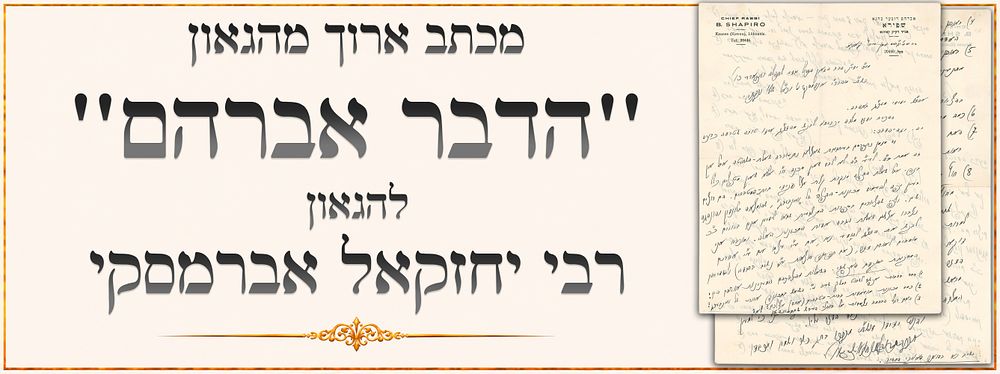
A Lengthy, Historically Significant Letter from the Gaon Rabbi Avraham Dov Ber Kahana Shapiro, Author of Devar Avraham and Chief Rabbi of Kovno, to Rabbi Yechezkel Abramsky of London, Concerning the Threatened Ban on Shechitah. 1938. - An important and historically significant letter from the renowned Gaon Rabbi Avraham Dov Ber Kahana Shapiro, Chief Rabbi of Kovno, to the Gaon Rabbi Yechezkel Abramsky in London, discussing possible solutions to the question of restrictions on ritual slaughter and the practical arrangements employed in London. The letter opens: “It was reported some time ago in the newspapers that the question of shechitah has arisen here, but, thank God, this is not true. At present, not only is there no danger, Heaven forbid, but the matter is not being addressed at all. However, the question of casting has attracted some attention among the officials of the slaughterhouse. They are favorably inclined toward installing the ‘Weinberg’ casting machines, which were invented in London and introduced there. “Since the illustrations in the technical literature that has reached us are not particularly clear, many questions have arisen here concerning these machines. I am therefore compelled to ask the honorable Gaon to inform us, either personally or through others who are experts in this matter… and to do so as soon as possible.” Rabbi Shapiro then enumerates eight detailed questions concerning the stunning machines used in London, beginning with the following: 1. How many animals can be slaughtered in one hour using a single Weinberg machine? The remaining questions address the technical operation and practical use of the machines, seeking detailed information that might assist the rabbinate in evaluating the proposed arrangements. At the conclusion of the letter, despite the considerable effort involved, Rabbi Shapiro notes that he is dispatching it on the very day it was written, 13 Nisan. He earnestly requests that Rabbi Abramsky photograph the machine at an appropriate scale and respond to every question during Chol HaMoed. In view of the religious importance of the matter, he urges him to send his reply by express post at the earliest possible opportunity. Historical Background: The letter refers to the Weinberg Casting Pen (also known as the “Weinberg apparatus”), sometimes mistakenly described as a “slaughtering machine.” It is a mechanical restraint device invented in 1927 by Harris Weinberg, an Orthodox Jewish tailor from Leeds. Its original purpose was to prevent animal suffering and improve safety during the process of casting—the stage in which an animal is positioned appropriately for kosher slaughter (shechitah). Preventing Painful Traditional Methods: Before the invention of this device, large animals such as cattle were brought into the recumbent position required for slaughter using manual methods, including tying their legs with ropes and pulling them onto their sides or hoisting them into the air. These methods caused considerable stress, fear, and serious injuries to the animals. The Rotation Mechanism (Inversion): The Weinberg apparatus consists of a padded compartment into which the animal enters while standing. Once the compartment is closed, the entire unit is mechanically rotated 180 degrees, turning the animal onto its back. This produces a natural extension of the neck, enabling the shochet to perform the ritual incision from above in a precise and rapid manner. During the 1920s and 1930s, the device was regarded as a humane breakthrough and was reportedly recommended and adopted through legislation in Britain and parts of Europe. The Gaon Rabbi Avraham Dov Ber Kahana Shapiro (1871–1943), author of Devar Avraham, was among the foremost rabbinic authorities of his generation. He was the son of Rabbi Zalman Sender Kahana Shapiro and son-in-law of the “Gadol of Minsk, ” Rabbi Yerucham Yehuda Leib Perelman. He studied at the Volozhin Yeshiva and served in the rabbinate of Smilovichi before being appointed in 1914 to the prestigious rabbinate of Kovno. Rabbi Abramsky subsequently succeeded him in Smilovichi. His celebrated halachic work Devar Avraham, whose first volume was initially published in 1906, established his reputation as a leading Torah scholar, and his analyses were discussed by prominent rabbinic authorities even during his lifetime. He was one of the leading figures of Lithuanian Jewry and its rabbinical association. In 1924, he traveled to the United States on the famous rabbinic mission alongside the author of Keli Chemdah, Rabbi Abraham Isaac Kook, and Rabbi Moshe Mordechai Epstein. When the Holocaust began, Rabbi Shapiro was visiting Switzerland. Nevertheless, he returned to Kovno, declaring that a ship's captain does not abandon his vessel in a storm. He died in the Kovno Ghetto, and thousands of Jews accompanied him to his burial. The recipient, the Gaon Rabbi Yechezkel Abramsky (1886–1976), Chief Rabbi of London,