Bidspirit auction | Letter of Recommendation from the
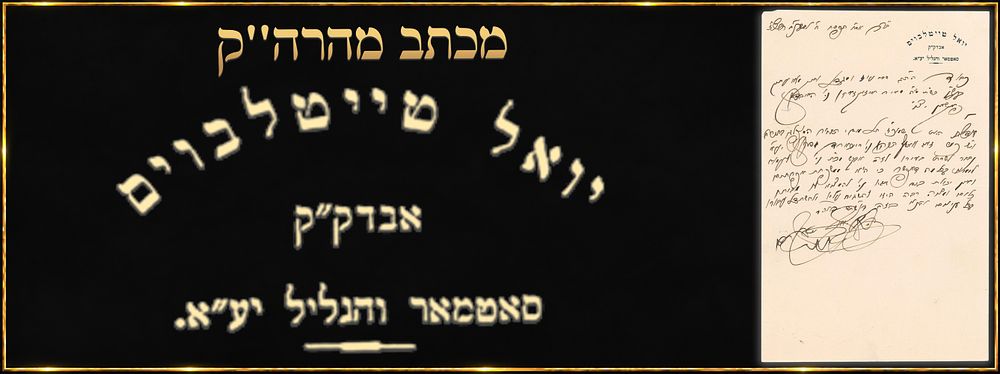
Letter of Recommendation from the Holy Rebbe of Satmar on Behalf of His Disciple. 1937. - Addressed to Rabbi Meir Isaacsohn, Rabbi of Focșani. Satmar, 1937. On official stationery. “Since the bearer of this letter, my disciple, the outstanding young scholar, distinguished in Torah and fear of Heaven, the esteemed Mr. Zev Wolf HaKohen Reichard, may he live, of this holy community, has been chosen to serve in his hometown, I hereby request that Your Honor assist him in every way possible, for he is indeed descended from an illustrious family.” The body of the letter is written in the handwriting of the Rebbe's personal attendant, with the Rebbe's own handwritten signature. Rabbi Meir Isaacsohn was born in 1910 to Rebbi Shlomo Isaacsohn, the Rebbe of Roman, son of Rebbi Yitzchak Leifer of Herța, and Sima Reizel, daughter of the holy Rebbi Meir of Kretshnif. He was named Meir after his maternal grandfather. Prior to his marriage, he studied at the yeshiva of Rebbi Menachem Mendel of Vișeu. He married Gittel, daughter of his uncle, the holy Rebbi Itamar Rosenbaum of Nadvorna. Following his marriage, he received rabbinical ordination from Rabbi Meshulam Roth of Satu Mare, author of She'elot U'Teshuvot Kol Mevaser. At the age of twenty-five, he was appointed Rabbi of Focșani, where he served for thirteen years. Following the Holocaust, he briefly served as Rabbi of Reichenberg. Upon the passing of his father on 12 Av 1947, he was summoned to succeed him as Rebbe of Roman. He also served as Chief Rabbi of the Romanian Armed Forces and became known for his cordial relations with the Romanian government, particularly with King Carol. In 1949, he immigrated to the United States, initially residing briefly in Crown Heights before settling in Philadelphia, Pennsylvania, where he established his synagogue. In 1975, he relocated to Staten Island, where he founded another synagogue and served as its rabbi until his passing in 2000. He was buried on the Mount of Olives in Jerusalem, in the section designated for the Nadvorna rebbes. Published in Ginat Veradim, vol. III (Av 2008).