Bidspirit auction | Extremely rare: Tuv HaAretz, Zolkiew,
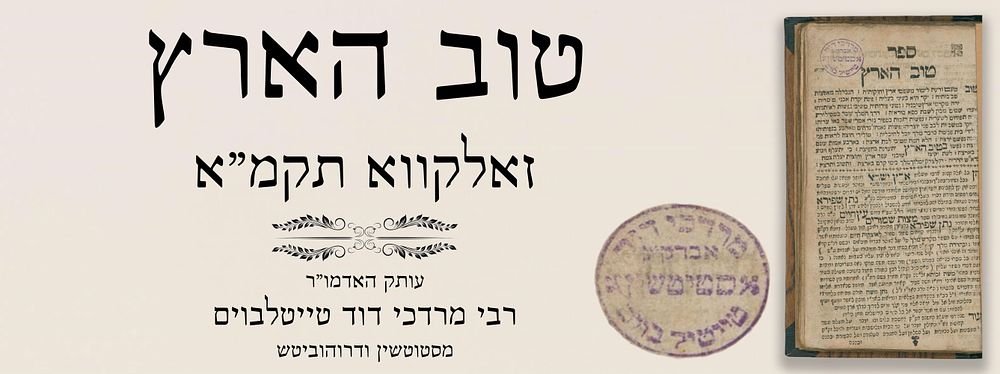
Extremely rare: Tuv HaAretz, Zolkiew, 1781. Copy of the Rebbe Mordechai David Teitelbaum of Stutchin and Drohobych. - Sefer Tuv HaAretz, concerning the praises and spiritual virtues of the Land of Israel, by Rabbi Nathan Shapira of Jerusalem. Very rare second edition. Zolkiew, 1781. Printed without a title page. At the beginning of the sefer appears the author’s introduction, in which he writes that his work is based on the writings of the Kabbalists of the Land of Israel—foremost among them the Arizal, his disciple Rabbi Chaim Vital, Rabbi Moses Cordovero, and Rabbi Abraham Azulai—“to make known … the mighty holiness of the Land of Israel at every day, every moment, and every hour… and to silence the mouths of those who speak falsely and bring forth an evil report about the Land.” Following the author’s introduction is the introduction of the editor, the kabbalist Rabbi Moshe Zacuto. Extremely Rare! It has never appeared at public auction. On leaf 62: “The editor Aryeh said:, I have resolved to present a fine teaching hidden in my satchel from the writings of the Arizal, concerning a matter relating to the rectification of the holy covenant. And this is its wording: ‘Now I will reveal to you a hidden secret which was revealed through the Arizal, namely what one should contemplate at the moment when he serves as the circumciser…’.” This passage was copied from a manuscript written by Rabbi Leib of Plevna, one of the disciples of the Arizal. Stamp of the Rebbe of Drohobych, Rabbi Mordechai David Teitelbaum (approx. 1846 – Kislev 1919), son of Rebbi Nachum Tzvi Teitelbaum of Drohobych (brother of the Yetev Lev and grandson of the Yismach Moshe), and son-in-law of the gaon and tzaddik Rabbi Chanina Horowitz, Av Beit Din of Olinov. He served as Av Beit Din of Stutchin and later as Av Beit Din of Drohobych. He was a cousin of the Rebbe of Munkacs, author of Minchat Elazar, and of the Rebbe of Sighet, author of Kedushat Yom Tov. In 1902 he immigrated to the Land of Israel, where he was considered among the leading figures of the community, and his name appears first on a public proclamation from that period. As a kabbalist and expert in the teachings of the mystical tradition, he was especially fond of the developing settlement in Meron, and at a certain stage moved to live near the tomb of the divine Tanna Rabbi Shimon bar Yochai. He also lived in Safed, where he was known as the Rebbe of Drohobych. His son was the Husiakov Rebbe, Rabbi Yitzchak Teitelbaum (martyred in the Holocaust), father of Rabbi Mordechai David Teitelbaum, the Rebbe of Husiakov–Be’er Sheva. The author, Rabbi Nathan ben Reuven Shapira (Maharansh; died 1666 or 1667), was among the great kabbalists and editors of the writings of the Arizal. He immigrated from Kraków to Jerusalem, where he was appointed rabbi of the Ashkenazic community. He later traveled to Italy as an emissary of the Land of Israel and died in the city of Reggio. He authored Matzat Shemurim, Yayin HaMeshumar, Torat Natan, and other works that remain in manuscript. [2], 62 Leaves. 18 cm.