Bidspirit auction | DOOLITTLE SCOUTS AN AIRFIELD TO
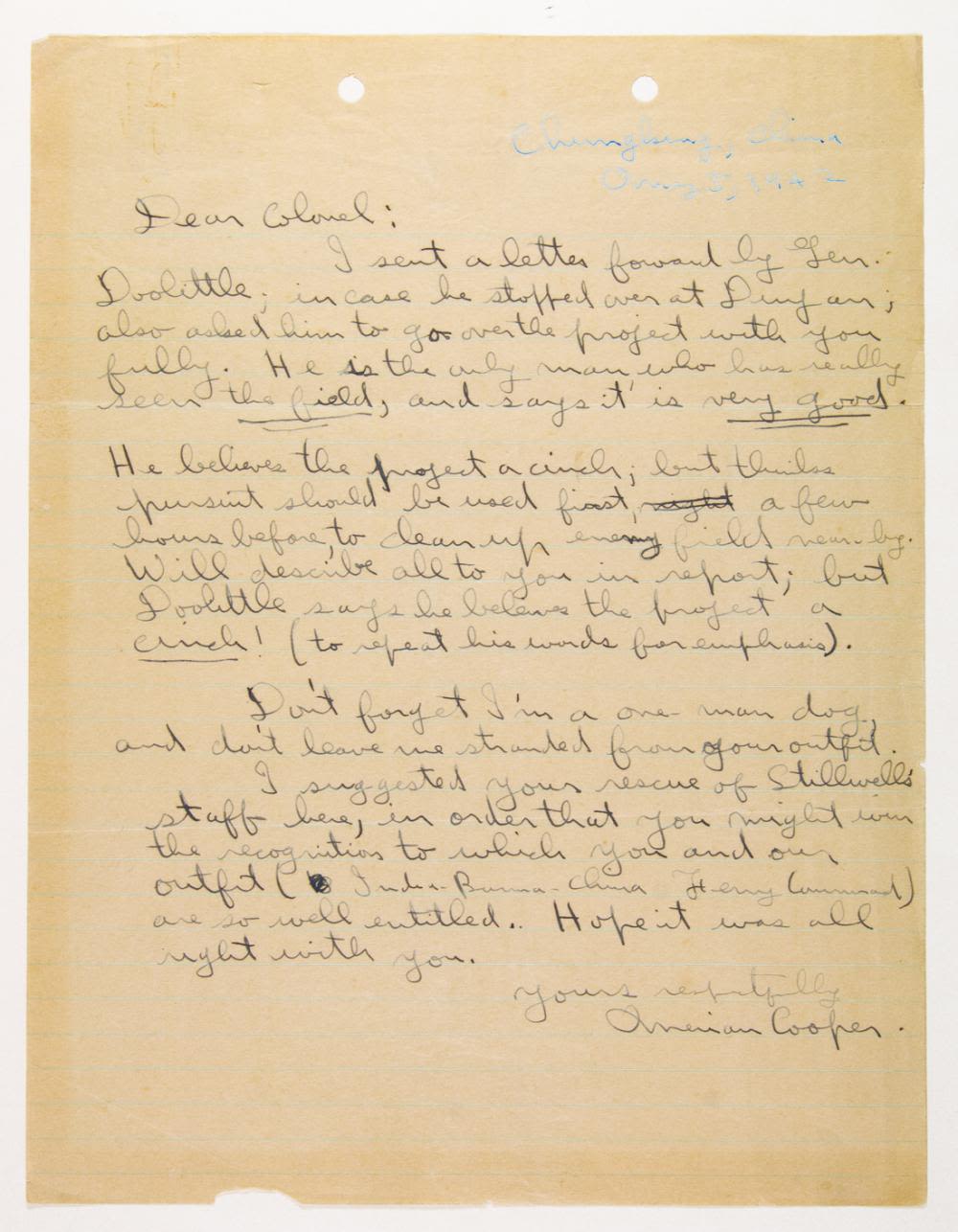
DOOLITTLE SCOUTS AN AIRFIELD TO BE USED TO BOMB JAPAN - MERIAN C. COOPER (1893-1973) American aviator, Army Air Corps and Polish Air Force officer and founder of the Kosciuszko Squadron during the Polish-Soviet War, and director and producer of King Kong (1939). Superb content and association war-date A.L.S. as Army Air Corps officer, Chungking, China, May, 5, 1942 to Col. CALEB VANCE HAYNES (1895-1966), then at Dinjan Airfield in Assam heading the Assam-Burma-China Ferry Command tasked with supplying American forces in China. Cooper mentions Doolittle's advance work on a proposed bombing attack on Japan by Haynes' 'Force Aquila', the advance party of the Tenth Air Force, using B-17s and B-24s flying from bases in the Zhejiang province of eastern China and supplied by C-47 Skytrains. In part: 'I sent a letter forward by General [James] Doolittle, in case he stopped over at Dinjan; also asked him to go over the project with you fully. He is the only man who has really seen the field, and he says it is very good. He believes the project a cinch, but thinks pursuit [aircraft] should be used first, a few hours before, to clean up enemy fields nearby...don't leave me stranded from your outfit...l suggested your rescue of Stillwell's staff here, in order that you might win the recognition.' File holes at top, a few tiny edge tears, else very good. A remarkable letter written only seventeen days after Doolittle's raid on Tokyo, showing his almost immediate return to field duty. Only one day before this letter was written, Haynes flew to rescue 30 members of Gen. Joseph Stilwell's mission when they got cut off in northern Burma, though Stilwell himself refused the lift, preferring to walk out with the remainder of his force. Haynes subsequently dropped supplies to Stilwell's group as they made their way west through the jungle. On one such mission, a Japanese fighter attacking his C-47 was discouraged into retreat when the crewmen of the supposedly unarmed transport opened up on it with fire from Thompson submachine guns and 45-caliber pistols. Doolittle had beaten Haynes to the punch, but Haynes remained determined to carry out his attack. Yet only weeks later, the intended forward fields were captured by the Japanese and the plan was canceled.